
Last updated November 4, 2026
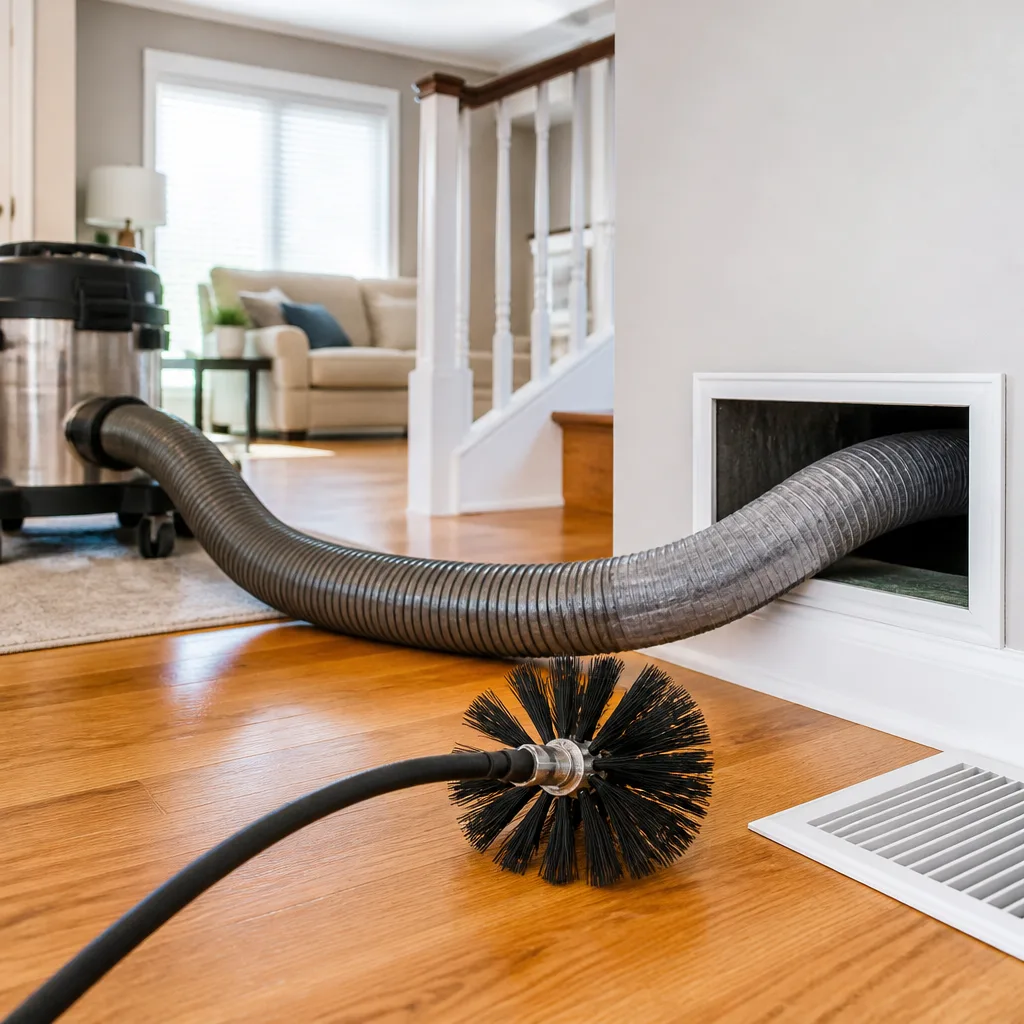 Whole-home duct cleaning
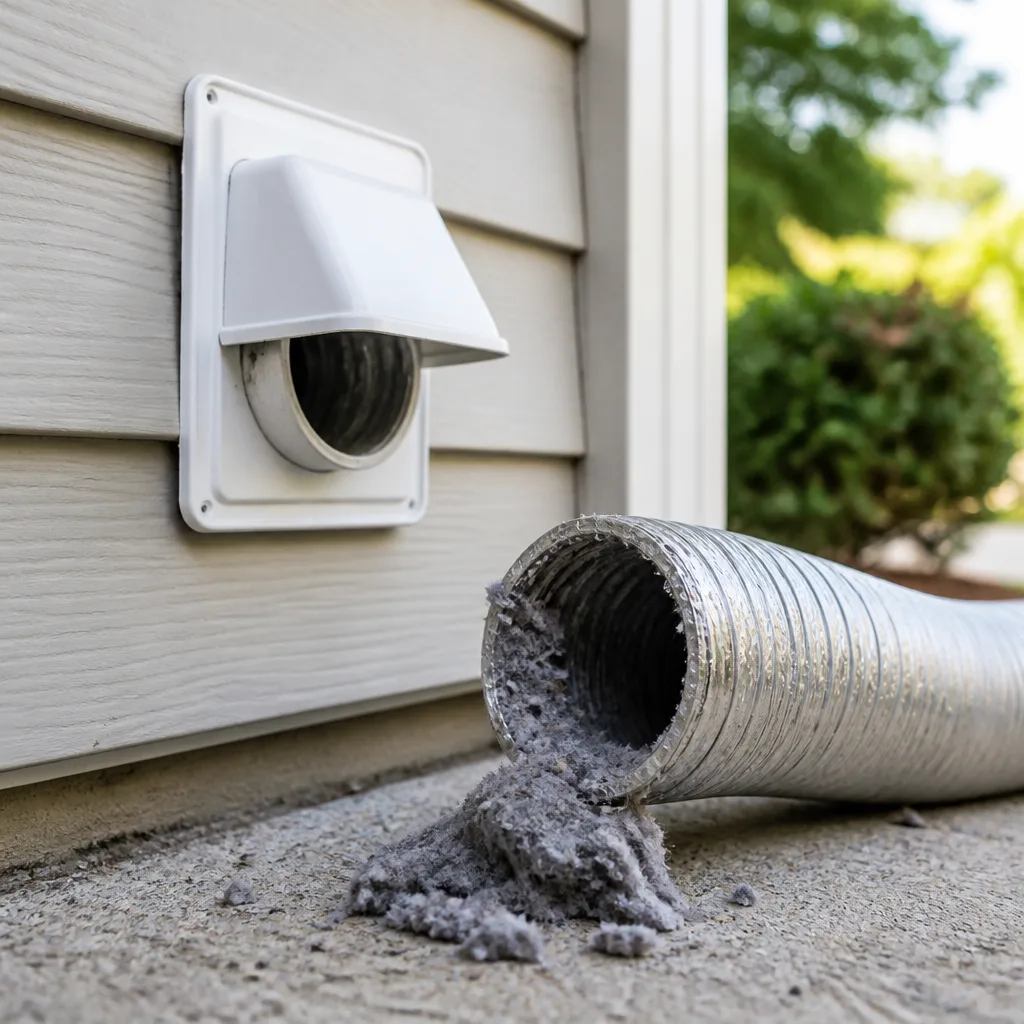 Dryer vent cleaning
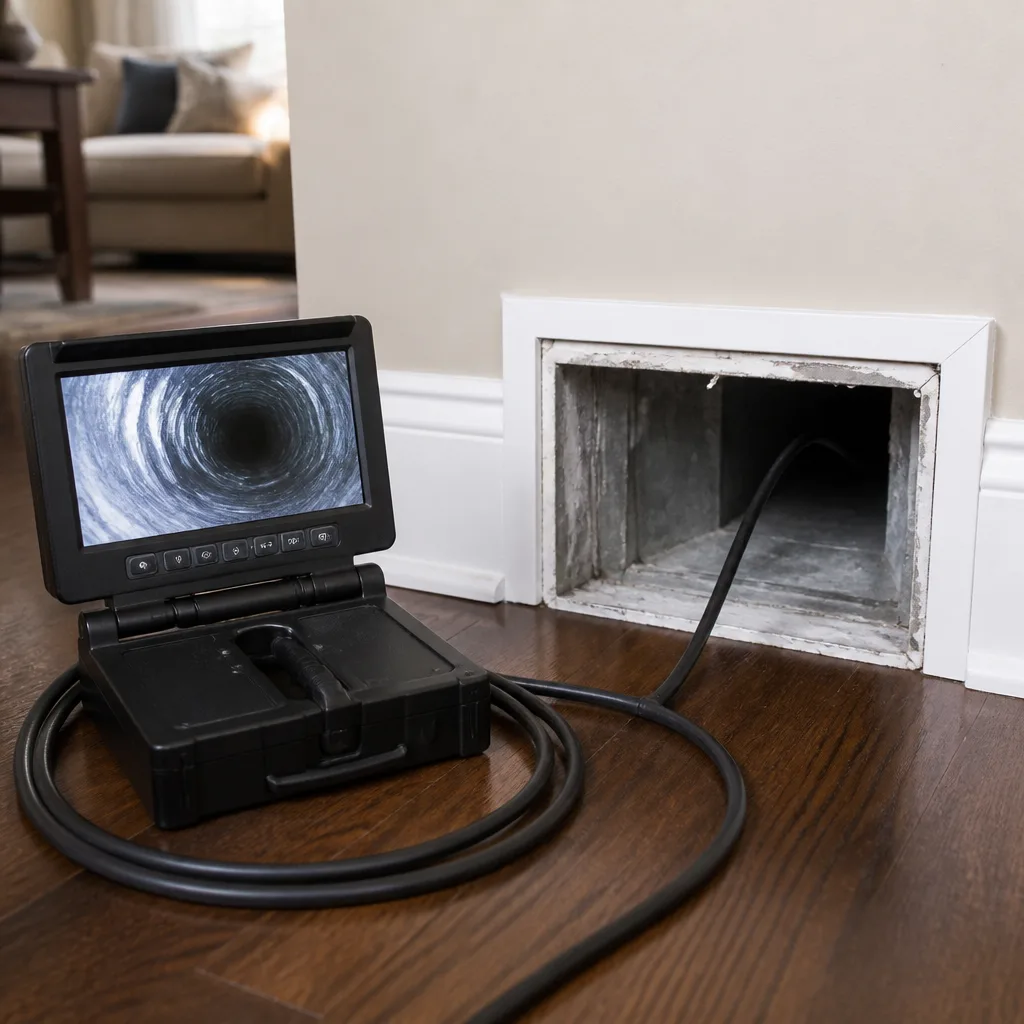 Camera inspection
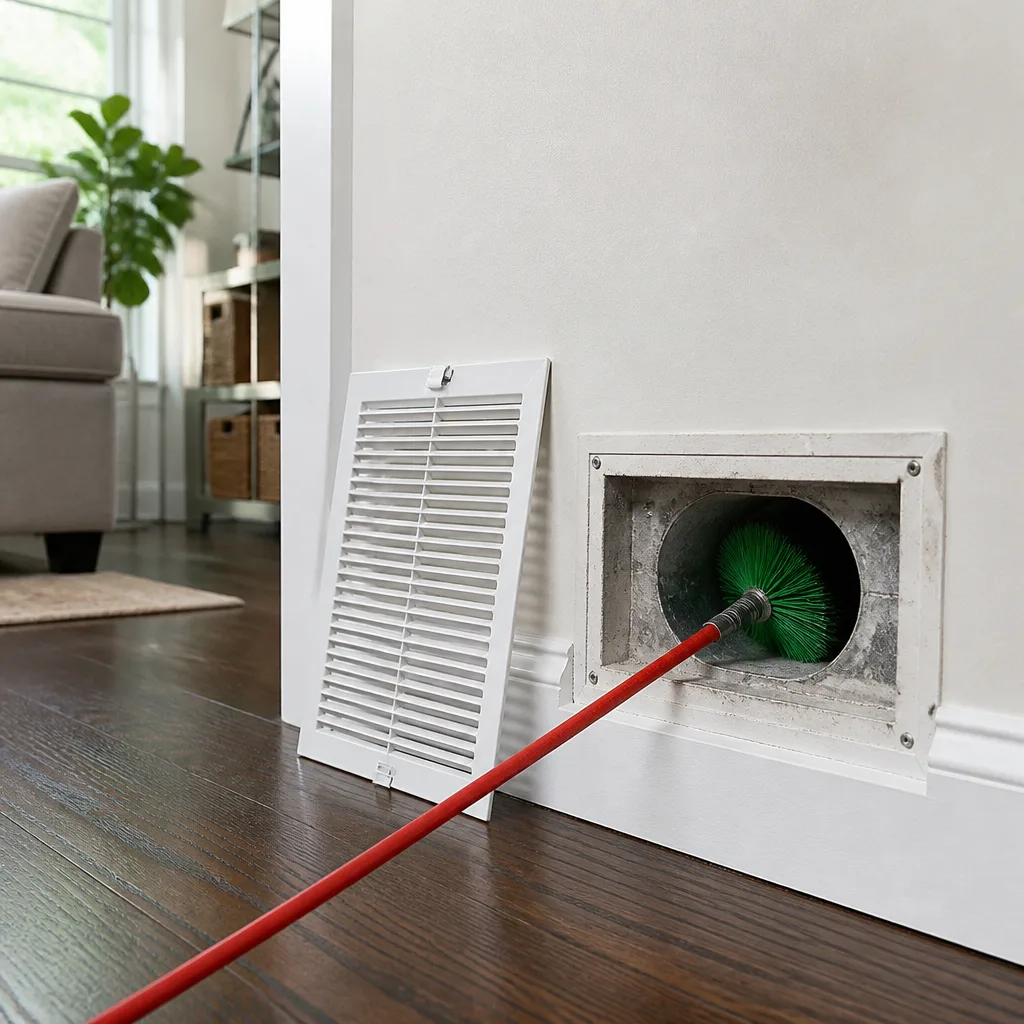 Sanitizing & deodorizing
Whole-system duct and dryer vent check with before-and-after photos - you see exactly what came out of your vents
That "$99 whole-house special" is a bait ad - the real number appears once they are in your hallway, or the "clean" is a shop-vac at the register. We photograph the inside of your ducts before and after instead.
Choosing the Right Air Duct Cleaning Brand: A Buyer’s Guide for Pico Rivera
Most homeowners in Pico Rivera never see the inside of their air ducts. They sign a work order based on a brand name, a logo, or a coupon, then trust that whoever shows up knows what they are doing. The reality is messier. The duct cleaning trade has almost no barrier to entry. Anyone with a van and a portable vacuum can print business cards, call themselves a specialist, and start quoting jobs. Worse, some of the biggest names in the industry operate as franchise marketing machines more than as technical service providers. The brand on the truck tells you less about the quality of the work than the equipment inside it, the training behind it, and whether the company treats duct cleaning as a real indoor-air-quality service or just a door opener to sell you other things. This guide is written to help Pico Rivera homeowners see past the label and evaluate what actually matters.
Quick Answer
The right air duct cleaning brand in Pico Rivera is one whose value is verifiable, not decorative. Look for a company that owns professional-grade negative-pressure equipment built for residential duct volume, can point to published industry credentials rather than vague certification claims, and handles duct repair and dryer vent safety as core services rather than afterthoughts. Avoid any company that leads with cheap whole-house pricing, rents portable machinery by the job, or pivots hard into air purifier and UV light upsells the moment they walk through your door. The brand should be a promise of process, not a logo on a van.
Styles & brands we work with
- Whole-home duct cleaning
- Dryer vent cleaning
- Camera inspection
- Sanitizing & deodorizing
Table of Contents
- What Equipment Brands Actually Mean
- Why NADCA Membership Matters
- The Upsell Red Flag
- Repair, Vents, and the Accountability Question
- How to Read Reviews Like a Technician
- Questions to Ask on the First Call
- Pico Rivera-Specific Considerations
- Common Mistakes to Avoid
What Equipment Brands Actually Mean
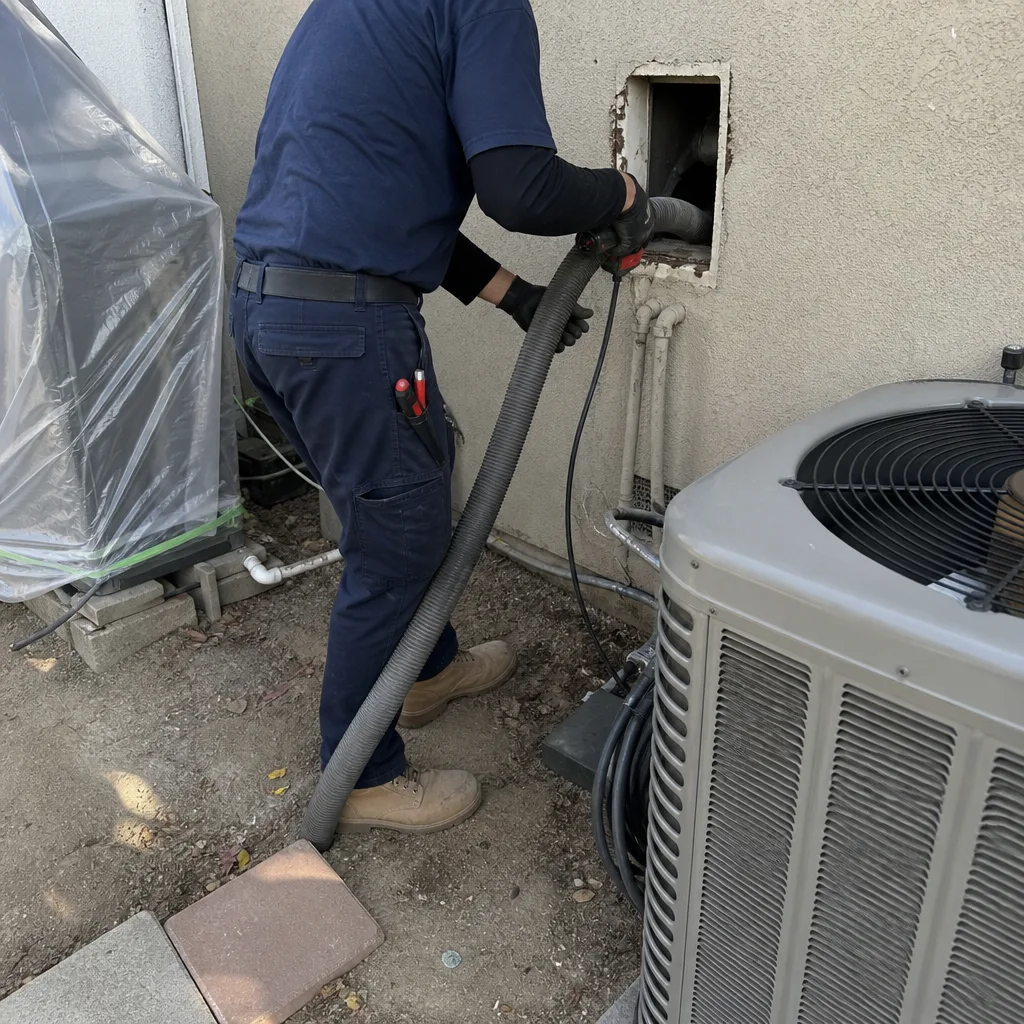
When a company says they use “professional equipment,” what does that word actually mean? In the duct cleaning trade, it means something specific. A proper residential duct cleaning job requires negative-pressure air movement: a powerful vacuum system that pulls air and debris out of the ductwork while agitation tools break material loose from the interior walls. The machine has to move enough cubic feet per minute of air to overcome the volume of the entire duct system, not just the branch nearest the return. Undersized equipment fails at this. It stirs up dust and allergens inside the ducts and leaves most of the debris in place. The homeowner sees a clean-looking register and assumes the job was done.
This is why the equipment brand matters. Professional systems from Nikro and Rotobrush are built for this exact application. Nikro has been manufacturing air duct cleaning and indoor air quality equipment for commercial and residential contractors for decades. Rotobrush is a name most HVAC professionals recognize: truck-mounted or portable units designed to achieve the negative air pressure and airflow rates that actual duct cleaning requires. These are not consumer tools. You cannot buy one at a home improvement store. They are the machines that commercial HVAC contractors use when they need to meet performance specifications, not just make a visual improvement.
What does that mean for your home in Pico Rivera? It means the difference between a machine that removes the settled dust, pet dander, and construction debris from the full length of your ductwork and a machine that simply agitates the first few feet of each branch. It also means the technician running that equipment has been trained on a platform designed for repeatable, verifiable results, not a cobbled-together shop-vac rig. When a company names the equipment they run, they are giving you something to check. Any company that says “we use professional tools” without naming a single brand is likely avoiding the question for a reason.
The Difference Between Owning and Renting Equipment
There is a quiet divide in the duct cleaning market between companies that own their equipment and companies that rent it per job. A company that owns Nikro or Rotobrush systems is making a capital commitment to the trade. They have invested in ongoing maintenance, replacement parts, and technician training that a transient operator has not. A company that rents a portable unit from a big-box hardware store for the weekend has no sunk cost in the quality of the work. They are not accountable to the machine, because the machine is not theirs. This is a structural difference, not a personality difference. It shows up in how carefully the job gets done.
When we talk to homeowners about air duct cleaning, the first question they ask is usually about price. The more revealing question is about equipment. Who manufactured the negative-pressure unit? What airflow rating does it achieve? How long has the company owned it? A straightforward answer to that question tells you more about the company’s technical capability than any number of reviews.
Why NADCA Membership Matters
The National Air Duct Cleaners Association keeps a public directory of every company that holds an active membership and certification. This single resource is more valuable than any review site, because it cannot be bought through a marketing agency. If a company in Pico Rivera claims NADCA certification but does not appear on the published member list, the certification does not exist. That one check eliminates a significant portion of unqualified operators in any market. It takes thirty seconds and tells you whether the company has any grounding in the standards that govern the trade.
So what does NADCA membership and ACR (Air Systems Cleaning Specialist) certification actually verify? It confirms that the company operates under the NADCA ACR standard, which sets requirements for how duct cleaning should be performed, how contamination should be removed, and how the work should be documented. It verifies that at least one technician in the company has passed an exam covering HVAC system design, contamination sources, cleaning methods, and safety procedures. It establishes that the company follows a defined scope of work rather than improvising once the register covers come off.
What NADCA certification does not cover is equally important. It does not verify pricing fairness. It does not guarantee that every technician on the truck is certified. It does not evaluate customer service, punctuality, or whether the company will upsell you aggressively. It is a baseline of technical competence and industry accountability, not a promise of a perfect experience. Think of it like a driver’s license: having one tells you something about the person behind the wheel, but it does not tell you how they drive in the rain.
For homeowners in Pico Rivera, this matters because the local market is small enough that the difference between trained and untrained operators is not always obvious. A certified company uses agitation tools in combination with negative pressure, during the cleaning process, rather than vacuum-only methods. They document the work with before-and-after photos. They follow a defined standard. An uncertified company might do any of those things, but there is no independent body verifying that they do. The Duct Cleaning Pico Rivera standard is to operate at the level the certification describes, whether or not the customer ever asks about it.
The Upsell Red Flag
Duct cleaning is a service that attracts two very different kinds of companies. The first kind does the work itself: mechanical agitation, negative-pressure extraction, inspection, and reporting. They make their money by cleaning ducts well. The second kind uses duct cleaning as a low-priced entry point, then transitions into selling air purifiers, UV lights, coil treatments, antimicrobial fogging, and other add-ons once they have a technician standing in your living room. This second model is pervasive in the industry because it is profitable. And it often leaves the actual duct cleaning half-done, because the cleaning was never the point.
Here is the tell: a company that quotes a whole-house duct cleaning at an obviously below-market rate is almost certainly planning to make up the difference on the back end. They are not running a charity. If the price is low enough to be a loss leader, you are the product being led. Once the technician is in your home, the pitch begins. Your ducts “need” a sanitizing treatment. Your coil “needs” a UV light. Your system “needs” a media filter. Each of these may have value in the right context, but when they are sold as urgent necessities discovered during a routine cleaning, the context is the sales script, not your home.
A specialist treats the mechanical cleaning as the deliverable. If we find compromised ductwork or excessive lint buildup during a dryer vent cleaning, we report it clearly and recommend repair or cleaning in the same visit. The recommendation is tied to an observed condition, not a product inventory. There is no incentive to sell you something you did not ask for. The work is the work.
When evaluating a company in Pico Rivera, ask about their service scope directly. What do they do during a standard cleaning? What do they consider outside that scope? What equipment do they use, and how do they document the condition of the ducts before and after? If the answer keeps veering toward products rather than process, that is the signal. You are not buying a cleaning; you are buying a pitch.
Repair, Vents, and the Accountability Question
Duct cleaning does not exist in a vacuum. The air pathway through your home includes the return and supply ducts, the plenum, the registers, and the connections between them. A crack, a separated joint, or a disconnected branch can pull attic air, crawlspace dust, or wall-cavity insulation into the airflow, reintroducing contaminants that the cleaning just removed. If the company that cleans your ducts cannot also repair them, you have a problem. You need one contractor to clean the system and a second to diagnose the leak. The cleaning company sees the symptom; the repair company guesses at the cause. Nobody is accountable for the result.
This is why a company that performs Air Duct Repair as a core service, not a referral, is a stronger choice. When the same technician who cleans the ductwork is qualified to identify and correct a separated fitting, a compression-damaged section, or an unsealed joint, the job is coherent. The diagnosis is based on direct observation inside the system, not a description relayed over the phone. The repair is part of the same service visit, not a second dispatch two weeks later. And the accountability is undivided: one company owns the entire air pathway.
Dryer vent cleaning deserves the same integration. Lint is flammable. A dryer vent clogged with accumulated lint is a fire hazard, full stop. That is not an upsell talking point; it is a mechanical reality. A company that treats dryer vent service as a dedicated line of work, with the same level of care as the duct cleaning, is signaling a safety philosophy. They understand that the vent is part of the home’s air pathway and that its failure mode is not inefficiency but combustion. A company that tacks “and we can also do your dryer vent” onto a duct cleaning quote is not treating it like the safety concern it is.
For a Pico Rivera homeowner, the practical advantage of a single specialist handling cleaning, repair, and Pico Rivera dryer vent work is straightforward. One contractor sees the whole pathway. One company is responsible for the diagnosis, the cleaning, and any corrective work that follows. You are not coordinating three different trades or mediating disputes about who missed what.
How to Read Reviews Like a Technician
Most homeowners read reviews the wrong way. They look at the star rating, skim the first three comments, and assume the consensus is meaningful. A five-star average with three hundred reviews sounds impressive until you notice that every review is a variation of “great service” and “nice guys.” Those are social reviews, not technical reviews. They tell you that the company was polite. They do not tell you whether the ducts were actually cleaned.
Here is a better approach, and it is the one we recommend when evaluating any company in Pico Rivera or anywhere else:
- Search reviews for process words. Look for mentions of specific methods: negative pressure, agitation, camera inspection, before-and-after documentation. A reviewer who uses those terms has seen something concrete. “They used a rotating brush and then a big vacuum” is a fundamentally different review than “they came out and cleaned the vents.”
- Search for outcome descriptions. The best reviews describe what changed after the job: less dust on furniture, reduced allergy symptoms, quieter airflow, no more musty smell when the AC kicks on. These are outcome anchors. A review that says “they did a great job” with no outcome is just politeness.
- Read the one- and two-star reviews carefully. Not for the complaints, but for the company’s responses. Does the company argue with the customer, dismiss the issue, or offer to make it right? A defensive response pattern is a structural signal about how they handle problems when the job goes sideways.
- Watch for upsell mentions. If multiple reviewers mention being pitched on air purifiers or UV lights during a cleaning, that is a systemic pattern, not a one-off. It does not appear by accident.
- Ignore reviews older than two years. Companies change equipment, crews, and ownership. A glowing review from 2021 tells you about a company that may no longer exist in that form.
In our experience, the most reliable indicator of a technically competent duct cleaning is a review that describes the process in detail and ties it to a change in the home’s air quality. Those reviews are rare, and they are worth their weight in whatever the star widget says.
Questions to Ask on the First Call
The first phone call is a diagnostic moment. You are not just getting a quote; you are gathering evidence about how the company thinks about the work. A technically fluent company answers direct questions with direct answers. A marketing-focused company answers with scripts and pivots. Here are the exact questions to ask, and what to listen for in the response.
- “What equipment do you use for the actual duct cleaning?” Listen for manufacturer names and a description of the process: negative pressure, agitation, airflow rates. Vague language like “powerful vacuum system” without specifics is a soft dodge. A professional answer names the equipment and explains why it is appropriate for residential duct volume.
- “Are you NADCA certified? Can you direct me to your listing?” A certified company will say yes immediately and tell you where to verify. A non-certified company will explain why certification is not necessary, which is the same as admitting they have not passed the industry’s baseline standard.
- “Does your crew handle duct repair if they find damage, or do you refer that out?” This single question sorts the specialist from the cleaning-only operator. If the answer is that they handle repair in-house, ask what repairs they commonly perform. If the answer is that they refer out, ask how the repair is diagnosed and who verifies the work afterward.
- “How do you determine the price?” Avoid any company that quotes a flat rate per vent or a whole-house price before seeing the property. The number of vents, the square footage, the accessibility of the system, the age of the home, and the length of the duct runs all affect the work. A credible answer describes an on-site written estimate based on the actual system, not a phone quote based on a marketing formula.
- “What does your documentation include?” A competent cleaning should include some form of before-and-after verification. This might be photos from an inspection camera, a written report of conditions found, or both. If the company cannot describe how they would show you what was done, they are asking you to take the work on faith.
- “Do you clean dryer vents as a standard service, and how do you verify the vent is clear after the cleaning?” The answer tells you whether dryer vent work is a real service line or a checkbox. A serious company describes the process: removing the lint from the full length of the vent run, verifying airflow at the exterior termination, and documenting the result.
Ask these questions in any order, but ask all of them. The pattern of answers matters more than any single response. A company that is comfortable being questioned is a company that has thought about its own process. A company that gets defensive when asked about equipment specifics is telling you the logo is the product.
Pico Rivera-Specific Considerations
Pico Rivera sits in the southeastern Los Angeles basin, about twelve miles from downtown LA, bordered by the Rio Hondo on one side and the San Gabriel River on the other. The homes here range from well-kept 1950s ranch houses to newer construction, and many have been through multiple renovations over the decades. That matters for duct cleaning because the age of a home dictates what you are likely to find inside the ductwork: decades of settled household dust, construction debris from renovations that predate current owners, and in some cases, pest intrusion or deteriorated flex duct that has been in place since the original build.
The local climate also shapes what accumulates in the ducts. Pico Rivera gets warm, dry summers and mild, low-humidity winters. During the hot months, residents run their air conditioning for long stretches, which pulls air through the return ducts continuously and deposits fine particulate on the interior surfaces. During the cooler months, heating runs create a similar cycle. The homes here are not dealing with extreme cold or moisture-driven mold risk the way houses in other climates are, but they do accumulate a steady load of dust, skin cells, pet dander, and general airborne material from the surrounding urban environment. The semiarid climate means that material tends to stay dry and airborne, rather than settling out. That makes it more likely to keep circulating through the system and re-entering the living space.
For Pico Rivera homeowners, the practical implication is that regular duct cleaning is not a once-a-decade event. The combination of an aging housing stock and a dry, dusty climate means that duct systems here can accumulate significant debris in a relatively short time. The right company understands this: they expect to find the kind of fine, settled particulate that is common in Southern California urban homes, and they bring equipment sized to handle it, not a portable rental unit designed for a single-room makeup.
We have seen the inside of enough ductwork in this area to know that the condition varies widely from home to home. A 1970s system with original flex duct will present differently than a 1990s system with rigid metal. The cleaning process is the same in principle, but the diagnosis is not. A company that treats every Pico Rivera home as interchangeable is not looking at what is actually in front of them.
What the Equipment and Product Brands Actually Signal
Beyond the duct cleaning equipment itself, the air-quality products a company works with reveal how they think about indoor air as a system. We work with filtration and IAQ products from Honeywell, Aprilaire, and Abatement Technologies, and we believe the brand names are worth understanding because they are anchors in a market full of unverifiable claims. Honeywell has been making residential and commercial air filtration equipment for decades, and its filters and media are used in homes and hospitals around the country. Aprilaire is a recognized name in whole-home ventilation and humidity control. Abatement Technologies specializes in air filtration for environments where particulate control is a serious matter, including healthcare settings.
When a company keeps these products in their working set, it suggests a specific standard of indoor air quality focus. These are not the cheapest filters on the shelf. They are products designed and specified for environments where allergen reduction and particulate control genuinely matter. A homeowner with children, pets, or respiratory sensitivities has a different set of priorities than a homeowner who just wants the registers to look clean. The right company has the same priorities.
What the brands do not signal is equally important. Working with a Honeywell or Aprilaire product does not constitute an endorsement by those companies, and it does not mean a cleaning will remove every allergen from a home. It means the contractor is familiar with a higher tier of filtration than the generic spun-fiber filters sold at retail. For a Pico Rivera homeowner who wants their duct cleaning to feed into a broader indoor air quality strategy, that familiarity matters. The Duct Cleaning Pico Rivera approach treats the cleaning, the filtration, and the ventilation pathway as one connected problem.
How Duct Repair Changes the Cleaning Conversation
A duct cleaning company that also performs repairs sees the system differently than a cleaning-only operator. The cleaning-only technician is there to remove debris. The repair-capable technician is there to assess the system: to look at the joints, the insulation, the flex runs, the register boots, and the connections to the air handler. The difference shows up in what gets caught and what gets missed.
Consider a common scenario: a homeowner notices dust accumulating on furniture even after a recent duct cleaning. A cleaning-only company returns, cleans the ducts again, and the dust reappears. The problem is not dirt in the ducts; the problem is a return duct pulling air from an unsealed crawlspace or wall cavity. A competent technician looking at the system as a whole will find that gap during the cleaning, mark the location, and recommend a repair. The repair closes the leak. The dust stops. That is the difference between treating the symptom and treating the source.
This is one of the reasons we emphasize that we are an air duct cleaning company that also handles repair, not a cleaning-only outfit. The ability to identify and correct compromised ductwork during the same visit means the problem gets addressed, not deferred. Homeowners do not need to coordinate a second company, schedule a second visit, or pay a second diagnostic fee. The same crew that found the problem fixes it and verifies the air pathway is now intact.
For Pico Rivera homes, where aging ductwork and past renovations often leave connections less than perfect, this integrated approach is not a luxury. It is a practical necessity. The duct system is the air delivery network for the entire home, and any leak in that network undermines the cleaning itself.
Dryer Vent Cleaning: The Safety Case That Changes the Priority
Lint is combustible. That is not a scare tactic; it is the reason dryer vent fires happen in residential properties every year. The vent run from the back of your dryer to the exterior termination accumulates lint over time, and because the vent is out of sight behind the appliance, the accumulation goes unnoticed until it becomes a problem. When airflow is restricted by accumulated lint, the dryer runs hotter, the exhaust temperature rises, and the risk of ignition increases. It is a slow-burn mechanical failure that most homeowners never think about until it is too late.
This is why dryer vent cleaning should never be an upsell afterthought. It is a dedicated safety service with a defined process. The vent must be accessed at both ends, the full length of the run must be cleared of lint and debris, and the airflow at the exterior termination must be verified to confirm the vent is actually clear. A visual inspection of the outside vent hood is not enough. The restriction is usually inside the run, not at the opening.
A company that folds dryer vent work into a broader “we can do that too” menu is not treating the service with the gravity it deserves. A company that lists it as a core service, with its own process and its own verification standard, is treating it as the fire-safety issue it is. In our work across Pico Rivera, we find dryer vents that have never been cleaned, on dryers that have been in the same spot for fifteen years. The lint load in those runs is not a minor inconvenience; it is a genuine hazard. The fix is straightforward, but only if someone actually does the work.
Common Mistakes to Avoid
- Choosing based on coupon pricing. A whole-house duct cleaning for $79 is not a deal; it is a math problem. The company cannot perform a legitimate negative-pressure cleaning at that price, so they are either leaving the work mostly undone or planning to make up the difference in upsells. A legitimate cleaning requires equipment, labor, and time. In Pico Rivera, the correct price reflects that.
- Believing unverifiable certification claims. “Fully certified” is not a credential; it is a phrase. If a company claims NADCA certification, verify it on the public member directory. If they are not there, the certification does not exist, regardless of what the website says.
- Ignoring the equipment question entirely. Most homeowners ask about price and availability. Almost none ask about equipment. That is a mistake, because the equipment is the single most revealing piece of information about the company’s technical capability. Ask for manufacturer names and model types.
- Trusting star ratings without reading the reviews behind them. A five-star average is meaningless if every review is a generic platitude. Read the reviews as evidence of process and outcome, not as a popularity score. Look for the words that describe what was actually done.
- Accepting a quote without an on-site written estimate. Duct systems vary from home to home in Pico Rivera: a 1,200-square-foot ranch with short metal runs is not the same job as a 2,400-square-foot two-story with extensive flex duct. Any company that quotes a firm price without seeing the system is pricing a different job than the one you have.
- Choosing a company that cannot repair what it cleans. If the technician finds a disconnected flex run or a leaking return plenum during the cleaning, the work is incomplete without a repair. A cleaning-only company leaves you with a diagnosis and no remedy; an integrated company can correct the issue on the same visit.
- Treating dryer vent cleaning as optional. Your dryer vent is part of the home’s air pathway, and its failure mode is fire. A company that takes the service seriously as a safety function is not the same as a company that will “check the vent” while they are already there. Ask about the process and the verification.
See the difference
 Before
 After
 Before
 After
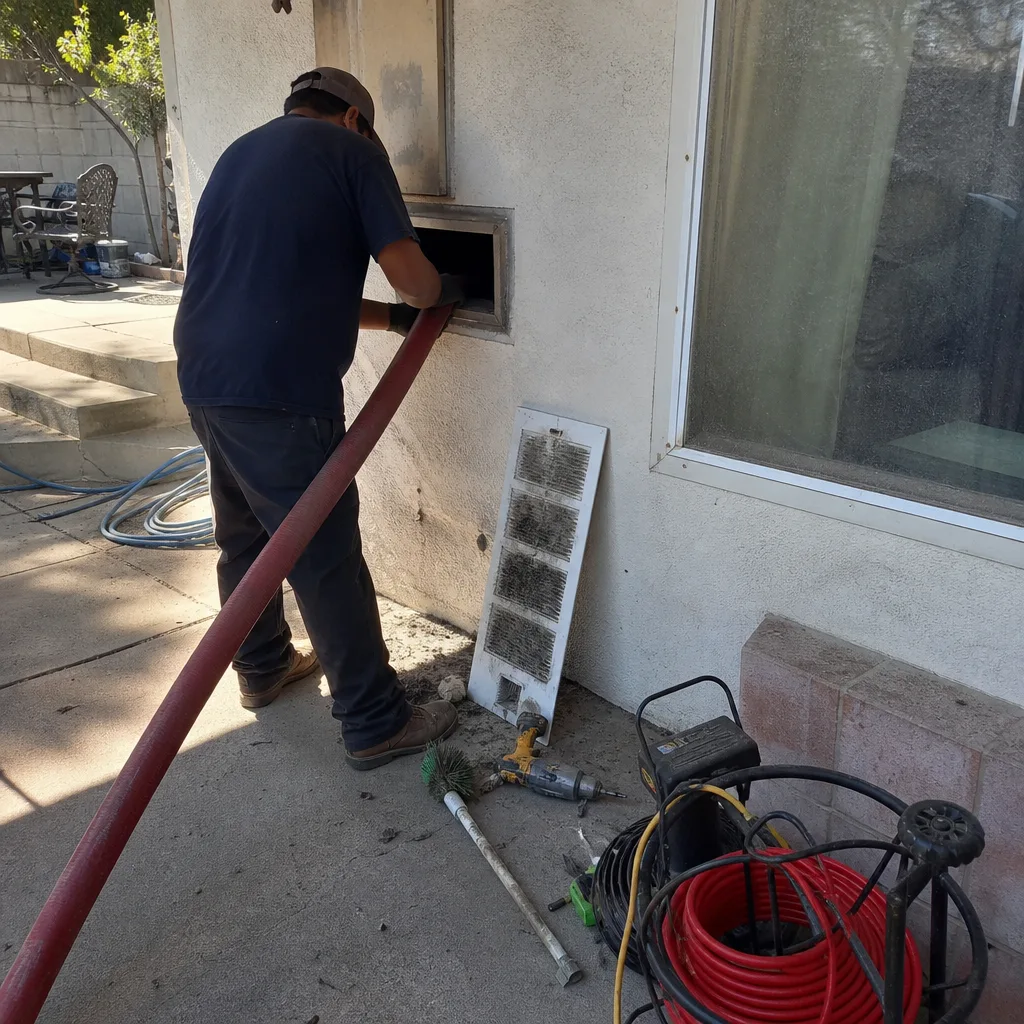 Before
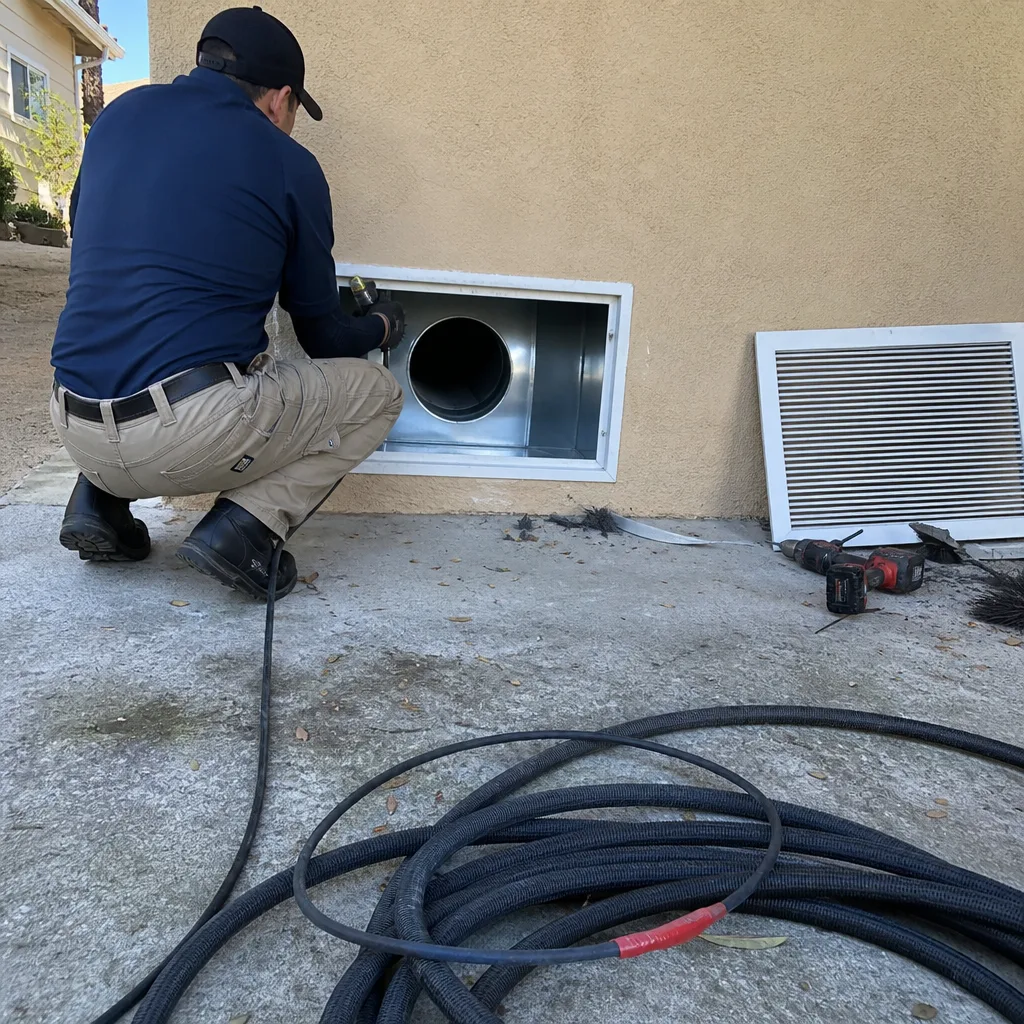 After
What a Real Job Looks Like
A legitimate residential duct cleaning in Pico Rivera follows a defined process, and it is worth knowing what that process looks like before you invite a company into your home. The exact steps vary by system and by company, but the structure is consistent among competent operators. Here is what should happen during the visit:
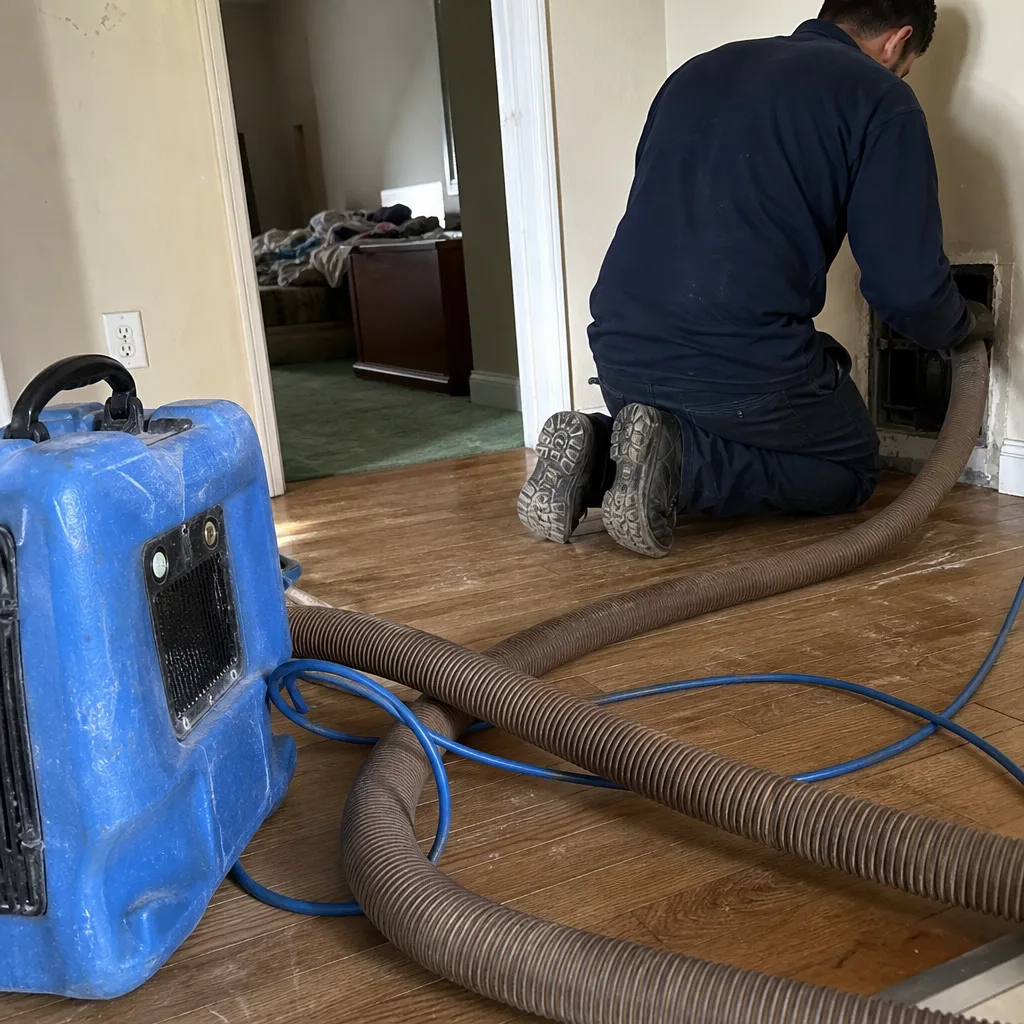
- Inspection before cleaning. The technician should inspect the system at the start: remove the registers, look at the accessible ductwork, check the return and supply plenums, and establish the current condition. If the system has never been cleaned or shows evidence of significant contamination, the technician should say so before starting.
- Equipment setup and negative-pressure establishment. A proper cleaning uses a high-powered vacuum unit connected to the duct system to create negative air pressure. This is not a portable vacuum attachment; it is a dedicated unit sized for the home’s duct volume. The negative pressure pulls loosened debris into the collection system rather than blowing it into the living space.
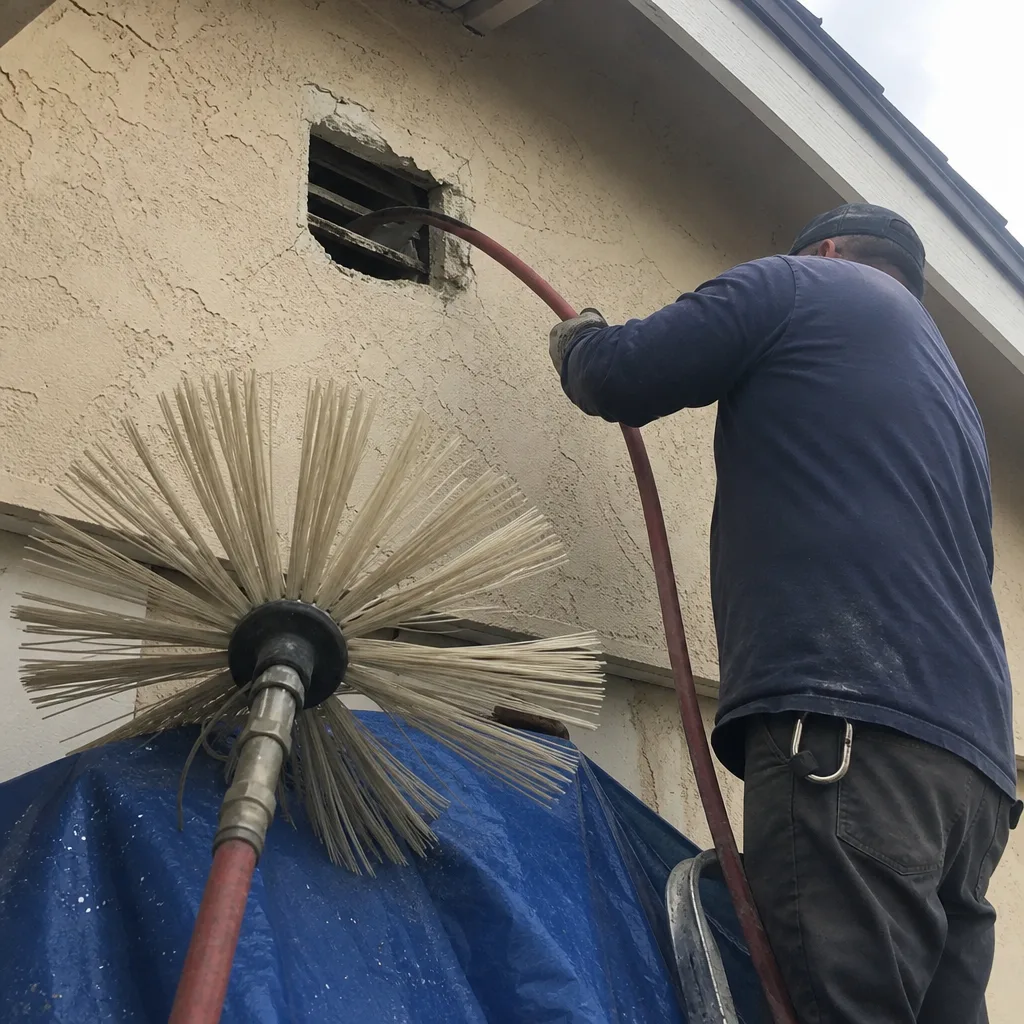
- Mechanical agitation of interior surfaces. Once negative pressure is established, the technician uses rotating brushes or other agitation tools to break loose the particulate that has adhered to the interior surfaces. The agitation is what separates a real cleaning from a light vacuuming of the register openings.
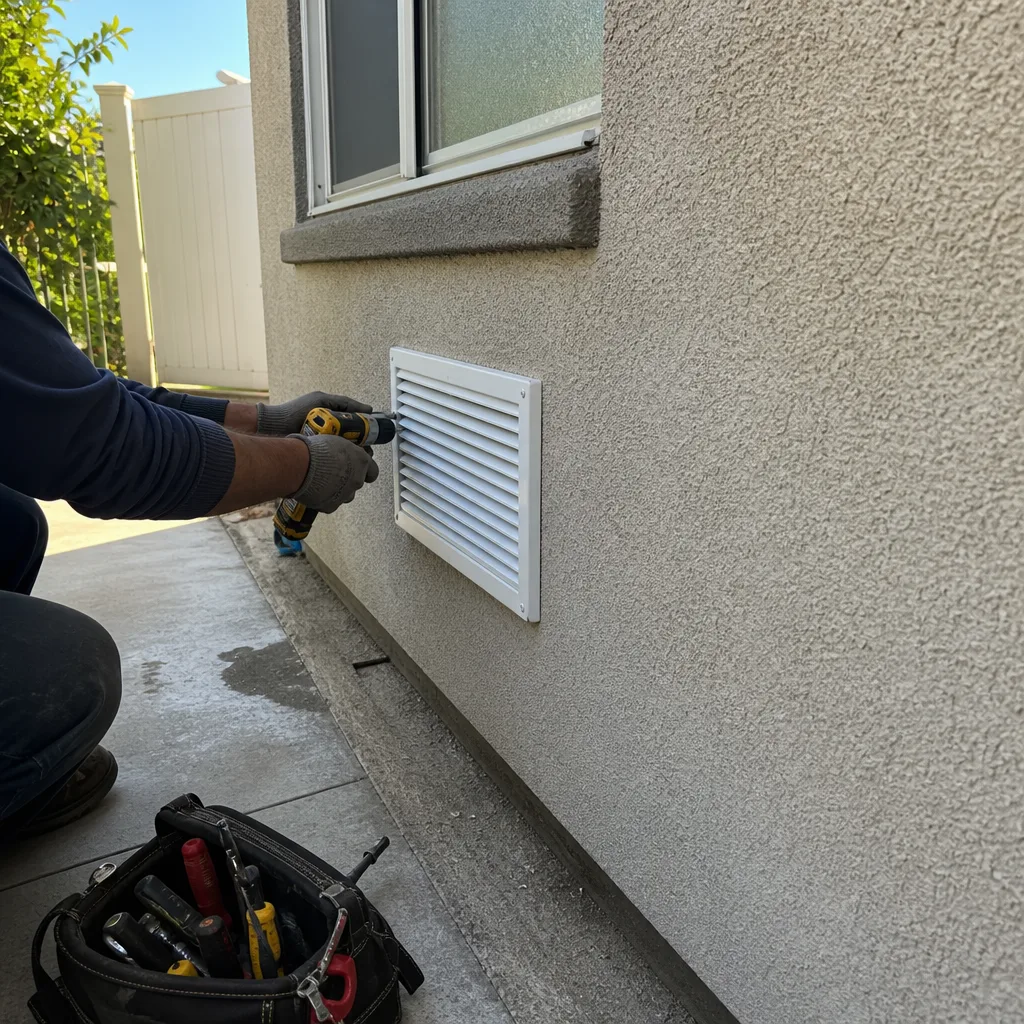
- Access and cleaning of hard-to-reach sections. Depending on the system layout, the technician may cut access points or open existing ones to reach deeper sections of the ductwork. Any access points created should be properly sealed and resealed after the work is complete.
- Post-cleaning verification. A competent company documents the result. This may involve inspection camera footage showing the interior before and after, written notes on what was found, or both. The verification is the difference between “we cleaned your ducts” and “we can show you that your ducts are clean.”
- Reporting on damage or repair needs. If the technician finds separated joints, damaged flex duct, or other structural issues, they should report them clearly and recommend repair. A company that can perform that repair in the same visit is giving you a complete service, not a partial one.
This is the standard to which we hold our own work. It is not proprietary; it is what the industry’s published best practices describe. The difference between companies is not whether they claim to follow this process, but whether they can show you the evidence that they did.
The Fee Structure: Why Free Estimates Matter
The estimate for a duct cleaning in Pico Rivera should come from an on-site visit, and it should be free. Free means the company is willing to put eyes on your system before quoting a price, because the quote is based on observed conditions, not a phone script. It also means the company is confident enough in its process that it does not need to charge you to show up. In our practice, the estimate is always free, and the final price is set per job by the written estimate, not by a menu of per-vent charges or a mysterious “whole-house” formula.
The written estimate matters because it locks the scope. A duct system with twenty-two supply runs, two returns, significant debris accumulation, and a connected dryer vent is a different job than a system with eight runs and minimal build-up. The estimate should describe what will be done, what equipment will be used, what the verification includes, and what the final price is. If the estimate is vague about any of those points, the work will be vague too.
When you call, the conversation should feel like an exchange of information, not a sales pitch. You are telling the company about your home, your concerns, and your system; the company is telling you about their equipment, their process, and their approach. If the person on the phone is uncomfortable with any of those questions, keep looking.
When to Call a Professional
There are moments when duct cleaning moves from a nice-to-have to a should-do-now. If someone in the home has persistent allergy symptoms or respiratory sensitivity that worsens indoors, the ducts are a reasonable place to look. If you can see dust accumulating rapidly on furniture and vents after cleaning, the problem is likely in the system, not on the surfaces. If your energy bills have crept up without a clear explanation, restricted airflow through a dirty system is a possible cause. If renovations have recently been completed, construction dust has likely entered the ductwork and should be removed. And if your dryer is taking longer than normal to dry clothes, or the exterior vent flap is not opening properly, the dryer vent needs attention immediately.
None of these are conditions a homeowner should attempt to address with consumer tools. Duct cleaning requires negative-pressure equipment and professional training; dryer vent cleaning requires access to the full run and verification of airflow at the termination. Duct Cleaning Pico Rivera offers free estimates in Pico Rivera. Call (833) 734-6877. We answer 24/7. Fast dispatch from 7am to 7pm, Sunday through Friday.
Frequently Asked Questions
Duct cleaning in Pico Rivera is priced per job based on the size of the system, the number of vents and returns, the accessibility of the ductwork, and the level of contamination present. There is no honest flat rate that applies to every home, because a 1950s ranch with short metal runs is a different job than a 1990s two-story with extensive flex duct. Our estimates are free and are based on an on-site inspection of the actual system. Call (833) 734-6877 to schedule an estimate for your specific home.
The answer depends on the home, the occupants, and the local environment. Pico Rivera’s warm, dry climate means air conditioning runs for long stretches each year, cycling air through the ducts and depositing fine particulate continuously. Homes with pets, children, or residents with respiratory sensitivities may benefit from cleaning every two to three years. Homes without those factors may go longer. The best approach is to have the system inspected and base the cleaning interval on what the inspection shows, not on a fixed calendar schedule.
Quotes that are dramatically lower than the market usually mean one of three things: the company is using undersized or rental equipment that cannot achieve proper negative pressure, the quote is a loss leader designed to get a technician into your home for upsell opportunities, or the company is not planning to perform a full cleaning and is operating on volume. None of those scenarios result in a correctly cleaned duct system. The low price is not a bargain; it is a different service wearing the same name.
Ask for before-and-after documentation. A competent company can show you inspection camera footage or photos of the interior duct surfaces before and after the cleaning. The documentation is the proof of work, and a company that cannot or will not provide it is asking you to take the result on faith. In our own practice, we verify the condition of the system at the start and document the result at the end, so the homeowner is not guessing.
The vent is the visible register where air enters or exits the room. Cleaning only the vents is a cosmetic service: it removes surface dust from the grille but leaves the interior of the ductwork untouched. The ducts are the full runs behind the walls, through the ceiling, and into the plenum, and that is where the settled particulate accumulates. A legitimate duct cleaning addresses the entire pathway, not just the visible openings.
Not necessarily, but any repair needs should be identified during the cleaning process. If the technician finds a separated joint, a damaged flex run, or an unsealed connection, those issues undermine the cleaning and should be corrected. A company that can handle repairs in-house can address the problem during the same visit, rather than sending you to a second contractor. The integrated approach is more efficient and more accountable, because one company owns the entire diagnosis and remedy.
The Bottom Line
Choosing the right air duct cleaning brand in Pico Rivera means looking past the logo and evaluating what is actually behind it. The equipment the company owns, the certifications it can verify, the service scope it actually performs, and the way it documents the work tell you more than any marketing slogan ever will. The right company runs professional-grade negative-pressure equipment, can name the manufacturers, performs duct repair as a core service rather than a referral, treats dryer vent cleaning as a fire-safety matter, and answers hard questions without flinching. If you are in Pico Rivera