
Last updated November 4, 2026
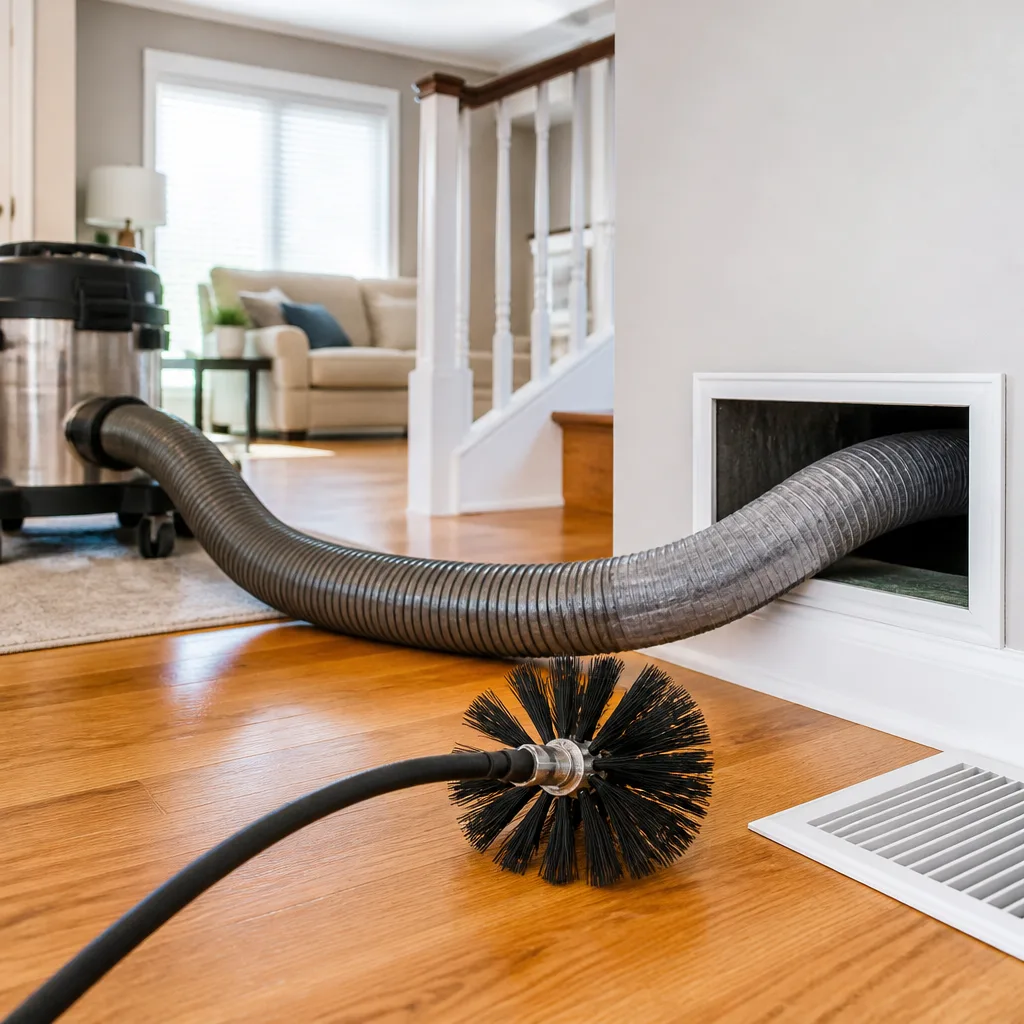 Whole-home duct cleaning
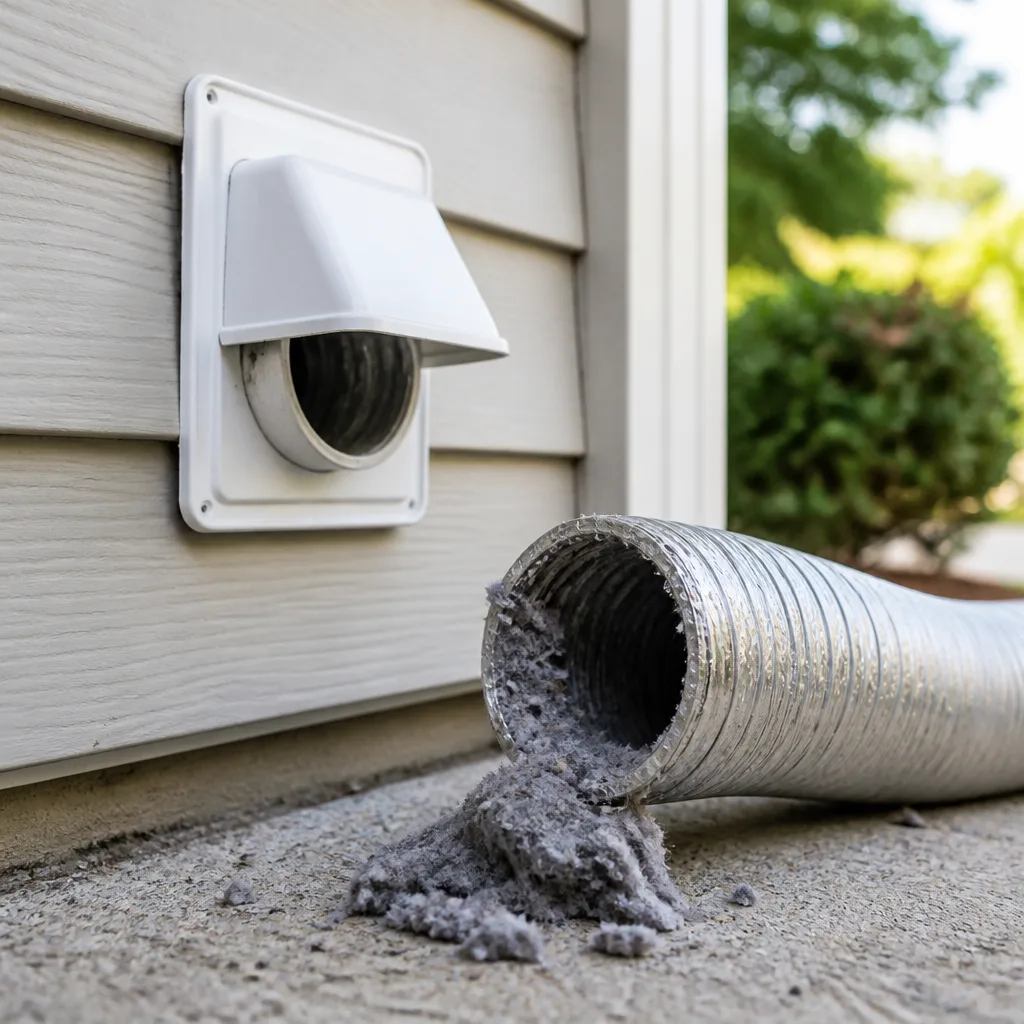 Dryer vent cleaning
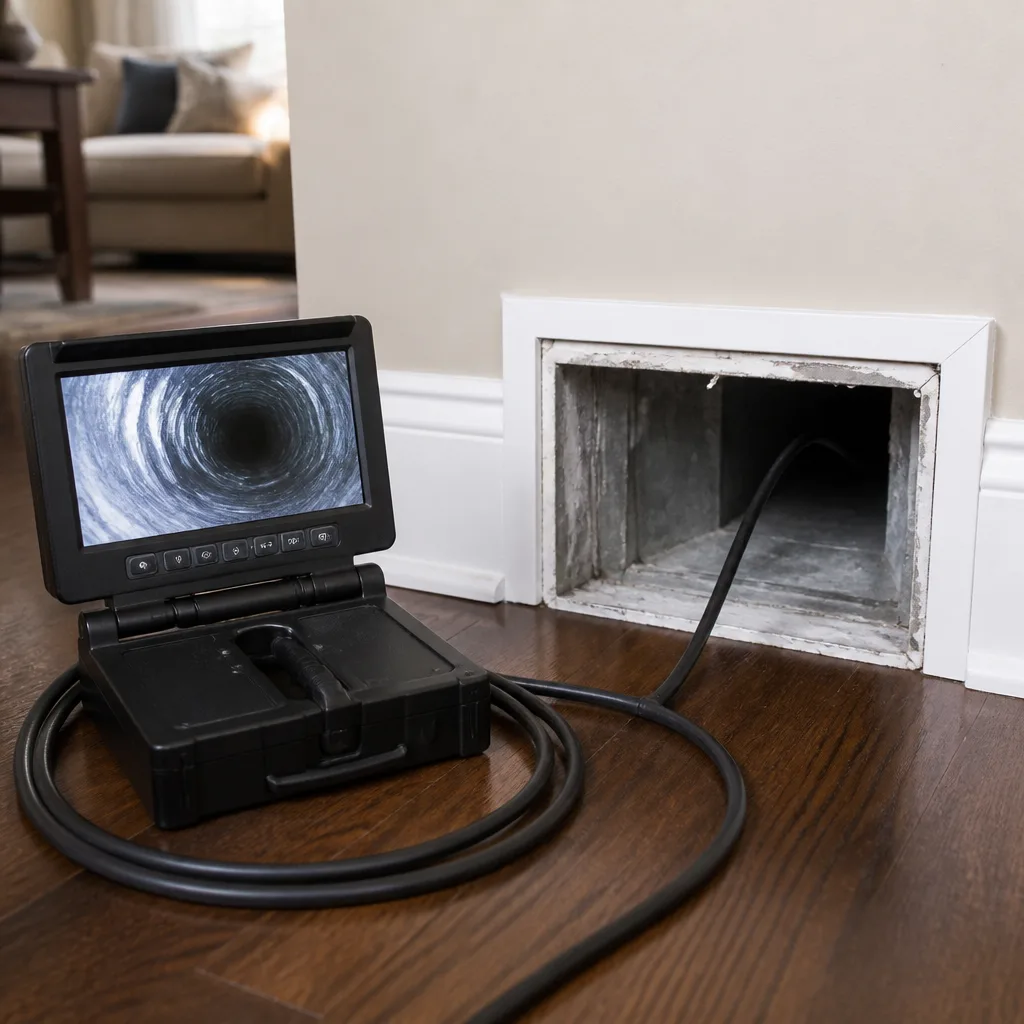 Camera inspection
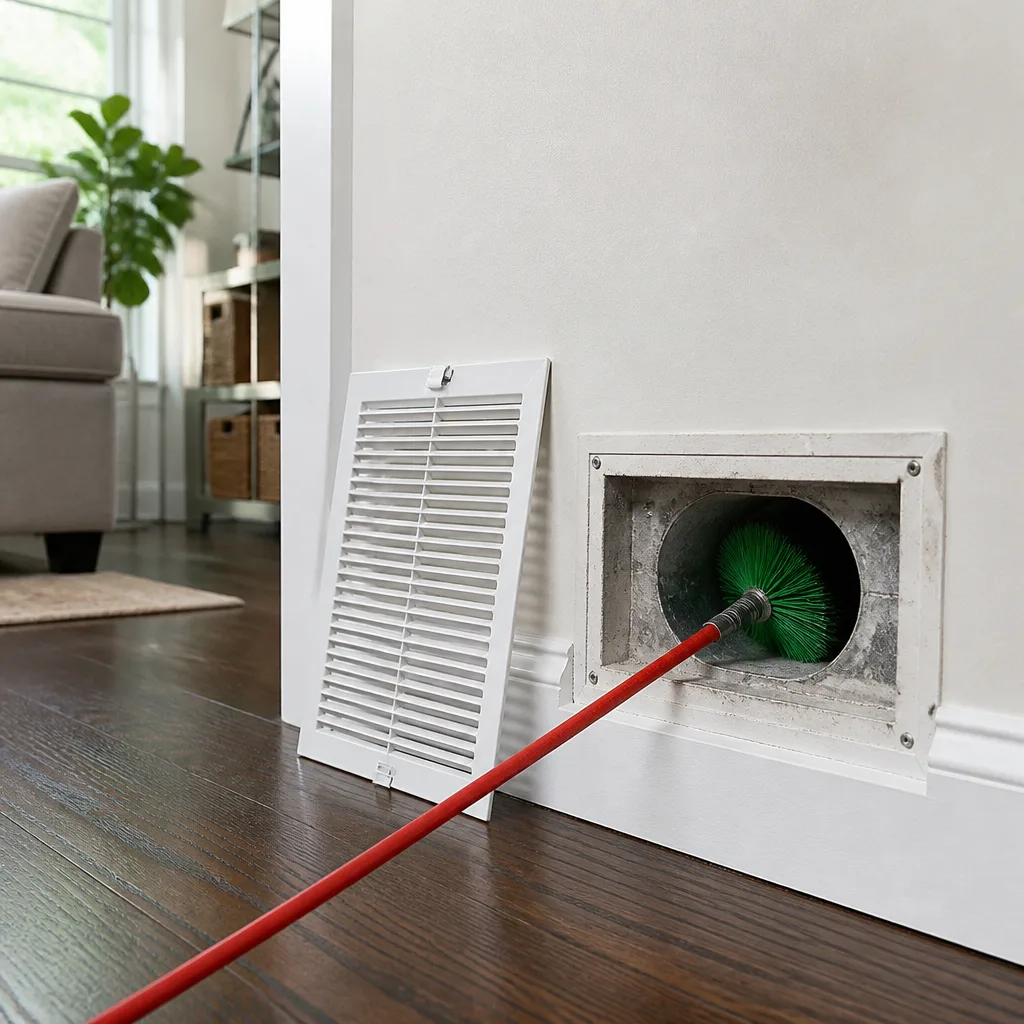 Sanitizing & deodorizing
Whole-system duct and dryer vent check with before-and-after photos - you see exactly what came out of your vents
That "$99 whole-house special" is a bait ad - the real number appears once they are in your hallway, or the "clean" is a shop-vac at the register. We photograph the inside of your ducts before and after instead.
Air Duct Cleaning Emergency Preparedness Guide for Pico Rivera Homes
Most homeowners in Pico Rivera think of their air ducts as a passive system that moves heated or cooled air from room to room. The misconception is that if the system is hidden, it is somehow isolated from the outside environment. The opposite is true: your ductwork is the first infrastructure in your home to interact with whatever is happening outdoors, whether that is smoke from a distant wildfire, particulate drift from the 710 corridor, or a sudden inversion layer that traps industrial emissions over the LA Basin. This guide covers the exact sequence for preparing your HVAC system before an air quality event, what to do while it is happening, and how to inspect and address the aftermath without causing further damage or simply waiting too long.
Styles & brands we work with
- Whole-home duct cleaning
- Dryer vent cleaning
- Camera inspection
- Sanitizing & deodorizing
Quick Answer
Duct cleaning after a wildfire or localized smoke event in Pico Rivera should follow a specific order: wait until outdoor air quality stabilizes, then change your filter, then have an inspection that checks the air handler coil, return boots, and filter housing for soot accumulation before any cleaning begins. The actual cleaning scope depends entirely on how long the system ran during the poor-air event and what kind of particulate entered the return side. A detailed inspection prior to cleaning is what separates a useful service from a wasted one.
Table of Contents
- Why Pico Rivera Is Different from the Rest of the LA Basin
- Pre-Event Protocol: What to Do Before Wildfire Season or a Known Air Event
- During the Event: Recirculation Mode, System Shutdown, and When to Switch
- Post-Event Inspection Sequence: What to Check Before Restarting
- What a Post-Emergency Duct Inspection Involves (and How It Differs from Routine Cleaning)
- Dryer Vent Emergency Prep: Ember Intrusion and Wind Events
- Filter Selection: What MERV Rating to Have on Hand
- Common Mistakes to Avoid
- When to Call a Professional
- Frequently Asked Questions
- The Bottom Line
Why Pico Rivera Is Different from the Rest of the LA Basin
Every city in Southern California deals with occasional smoke and smog, but Pico Rivera has a specific combination of risk factors that makes proactive duct management more important here than in coastal or foothill communities. The city sits in a valley position near the confluence of several major transportation arteries, and prevailing wind patterns can push particulate from multiple sources across a relatively contained area. During the 2020 Bobcat Fire, air quality in the LA Basin reached AQI levels above 200 for multiple consecutive days. Every HVAC system running in recirculation mode during that window was filtering some of that smoke through ducts that then retained the particulate. That is not hypothetical: it is how residential forced-air systems work. The fine soot that bypasses or accumulates on a standard filter enters the return air stream, coats the interior surfaces of supply and return ducts, and remains there until physically removed.
What makes Pico Rivera worth treating differently from, say, a beach city with constant onshore flow is the layering of sources. A system that handled wildfire smoke in September may still be carrying a residual soot film when a localized industrial emission event occurs in November. The ducts do not distinguish between sources. They accumulate whatever passes through them. For homeowners who have never had their ducts inspected after a significant smoke event, the system may be recirculating particulate from an event that ended months ago. That is why air duct cleaning in this part of Los Angeles County is less about routine maintenance and more about reducing an ongoing exposure source that most people never see.
The neighborhood-level variation also matters. Areas closer to the 710 corridor, such as the neighborhoods west of Rosemead Boulevard, experience different particulate loading than the quieter residential streets east of the river channel. The point is not that one part of Pico Rivera is safe and another unsafe, but that the same HVAC protection protocol applies citywide, and the frequency with which you need to act depends on your exact proximity to high-traffic industrial and freeway corridors. A home two blocks from Washington Boulevard with a high static-pressure duct system will accumulate more in six months than a well-sealed home in a cul-de-sac might accumulate in two years.
Pre-Event Protocol: What to Do Before Wildfire Season or a Known Air Event
The time to prepare for an air quality emergency is not when the sky is orange. It is during the spring and early summer months, before the Santa Ana wind season begins and before wildfire risk peaks across the region. The steps below apply to any home in Duct Cleaning Pico Rivera territory, but they are especially important for households with children, pets, or anyone with a respiratory condition. The goal is to have the system configured so that when a smoke event arrives, you are not making decisions about filters, thermostat settings, or outdoor intake positions under pressure.
- Have the right filter installed before you need it. A MERV 13 filter is the standard recommendation for wildfire smoke because it captures particles in the 0.3 to 1.0 micron range that make up the majority of dangerous smoke particulate. Do not wait until the smoke starts to buy one. Keep a spare in the garage or utility closet. If your system cannot handle a MERV 13 due to static pressure limitations, a MERV 11 is the minimum for meaningful smoke protection.
- Know whether your system has a fresh air intake. Some homes in Pico Rivera, especially newer construction or homes with energy recovery ventilators, pull outdoor air directly into the return side. If you have a fresh air intake, locate it and know how to close it. If you cannot close it, plan to operate the system in recirculation mode only during events.
- Schedule a pre-season duct inspection. A routine inspection before the smoke season tells you the baseline condition of your system. If there is existing dust buildup or a return-side leak, a smoke event will magnify the problem significantly. We recommend having a professional inspect the air handler coil, filter housing, and return air grilles in late spring so you know what you are starting with.
- Test your thermostat’s fan and recirculation settings. Make sure you know how to set your system to “fan only” or “recirculate” rather than “auto.” During a smoke event, you may want to run the fan intermittently with a high-MERV filter to scrub indoor air without pulling new outdoor air through the coil. Learn the setting now, not when the AQI is already rising.
- Clear the return air grilles. Walk through the home and make sure no furniture, boxes, or stored items are blocking any return air grilles. A blocked return forces the blower to work harder and increases the amount of particulate pulled through the return boots during a smoky period. This is especially true in single-story Pico Rivera homes where hall closet returns are common.
Pre-event preparation also includes a basic understanding of how particulate behaves inside a duct system. Smoke is not a uniform cloud. It behaves like a suspension of very fine solids that settle as soon as air velocity drops. That means the interior surfaces of your ducts accumulate more soot when the system runs less frequently. A system cycling for ten minutes every hour gives particulate a lot of time to settle between cycles. A system running continuously keeps more particulate in suspension, but it also pushes more of it through the filter. Neither scenario is good, but understanding the dynamic helps explain why different homes in the same neighborhood emerge from the same smoke event with very different duct conditions.
During the Event: Recirculation Mode, System Shutdown, and When to Switch
The decisions you make while the smoke is actively blanketing the region determine how much remediation your system requires afterward. The core choice is between running the system in recirculation mode with a high-MERV filter, or shutting the system down entirely. Both approaches are valid under different conditions, and the correct decision depends on your indoor air quality, not just the outdoor AQI.
When to use recirculation mode: If outdoor AQI is elevated but your home is reasonably tight and indoor air quality is still acceptable, setting the thermostat to “fan on” or “recirculate” with a MERV 13 filter installed allows the system to act as a whole-house air scrubber. This approach is most effective early in an event, before indoor particulate levels have risen significantly. Homes in Pico Rivera with newer windows, sealed door sweeps, and a properly functioning filter rack can maintain decent indoor air quality for several days this way. The system is not pulling in fresh outdoor air in this mode unless you have a fresh air intake open, so the filter is only dealing with particulate already inside the home plus whatever infiltrates through the building envelope.
When to shut the system down entirely: If outdoor AQI exceeds 200 and remains there, or if your system does not have a high-MERV filter installed, or if anyone in the home is experiencing throat irritation, headache, or respiratory symptoms, shut the system off. A standard fiberglass filter or a low-MERV pleated filter catches almost no smoke particulate, and running the system in those conditions simply coats the blower, coil, and ducts with a soot layer that will later require professional removal. Shutting down also prevents the system from cycling on during an event when a thermostat calls for cooling and inadvertently pulling smoky air through the coil.
The critical detail most homeowners miss is what happens when the event ends and the system restarts. If the system was shut down during the event and the filter was not changed before restart, the accumulated soot on the filter can be pulled deeper into the system as the fan ramps up. The same applies if the filter was downgraded during a previous routine change and never upgraded back. Before restarting after any significant smoke event in Pico Rivera, change the filter first. Then consider whether the system needs an inspection before regular operation resumes.
Post-Event Inspection Sequence: What to Check Before Restarting
The period immediately after a smoke event is when homeowners make the most errors. The instinct is to either ignore the system entirely because it “sounds fine” or to call for a full cleaning without first establishing what actually needs to be addressed. The correct sequence is inspection first, then a cleaning decision based on what the inspection reveals. Here is the order of operations for any home in Pico Rivera following a wildfire smoke event or a localized industrial particulate release.
- Verify that outdoor air quality has returned to acceptable levels before opening windows or restarting a system that was shut down. If you restart too early, you pull residual outdoor particulate into the home and into the system. Wait for a sustained AQI reading below 100, ideally below 50, before moving to the next step.
- Change the filter. Do this regardless of how old the current filter is. A smoke event can load a MERV 13 filter to full saturation in 48 to 72 hours. Remove the old filter carefully and bag it before disposing of it. Inspect the filter housing while the filter is out: look for soot streaks, dark residue on the housing walls, or visible particulate accumulation around the filter edges. Those are signs that the filter was not sealing correctly and smoke bypassed it.
- Inspect the air handler coil. This is not a visual task for most homeowners because the coil is behind an access panel, but it matters. If the coil is coated with a fine soot film, it will not transfer heat efficiently and future cooling cycles will blow residual particulate into the living space until the coil is cleaned. A professional inspection includes a coil condition check using a scope or by pulling the access panel.
- Check the return air grilles and boots. Remove a few of the return grilles and look inside the boot with a flashlight. If you see gray or black soot streaking, the return side was pulling smoky air and the ducts need attention. Supply registers should also be checked, but the return side is where most particulate enters and settles first.
- Inspect the supply registers for soot streaking around the edges. This is a sign that smoke particulate is being blown into the rooms and then re-entering the airstream through the return ducts. If the supply registers are streaked but the return boots are clean, the issue may be more limited in scope.
- Run the fan briefly on “fan only” after the filter is changed and the visual inspection is complete. Listen for any odd sounds and pay attention to whether the airflow feels normal. Do not run the air conditioning or heating until you are confident the coil is not heavily loaded.
If any of these steps reveal soot accumulation, discoloration, or airflow issues, the system should be professionally inspected before normal operation resumes. The air handler coil, filter housing, and return air grilles are the three most common places smoke residue settles in Pico Rivera homes, and all three require a trained professional to properly assess. This sequence also applies to homes that experience localized industrial particulate events along the 710 corridor. The response protocol is the same, even if the source is different.
What a Post-Emergency Duct Inspection Involves (and How It Differs from Routine Cleaning)
A post-emergency duct inspection is not the same thing as a routine pre-summer check, and it is not the same thing as a duct cleaning. The inspection is the step that determines whether cleaning is necessary, what scope of cleaning is appropriate, and whether there is a secondary issue such as a damaged boot or a disconnected return that requires repair. Skipping straight to cleaning without an inspection can mean paying for a service that does not address the actual problem, or worse, running high-velocity cleaning tools through a system that has a pre-existing weakness.
The sequence matters for a simple reason: inspection first establishes the spatial distribution of the contamination. If the smoke entered through a single return air grille on the west side of the home and the blower was off during the event, the contamination is likely limited to the return side near that grille. If the system ran throughout the event, the contamination will be distributed across the full length of both supply and return ducts. A proper cleaning addresses the entire system in the second case, but only the affected section in the first case. Pricing and time requirements vary significantly, which is why no honest estimate can be given over the phone before someone looks at what actually happened.
A post-emergency inspection includes several components that a routine check does not. It includes a filter housing inspection to verify that the filter was sealing properly during the event. It includes an air handler coil evaluation using a scope or by removing an access panel to look for soot accumulation on the coil face. It includes return boot inspection at each grille, not just a representative one. And it includes an assessment of whether the duct walls themselves are holding enough soot to justify mechanical cleaning, which cannot be determined from a register photo or a phone description.
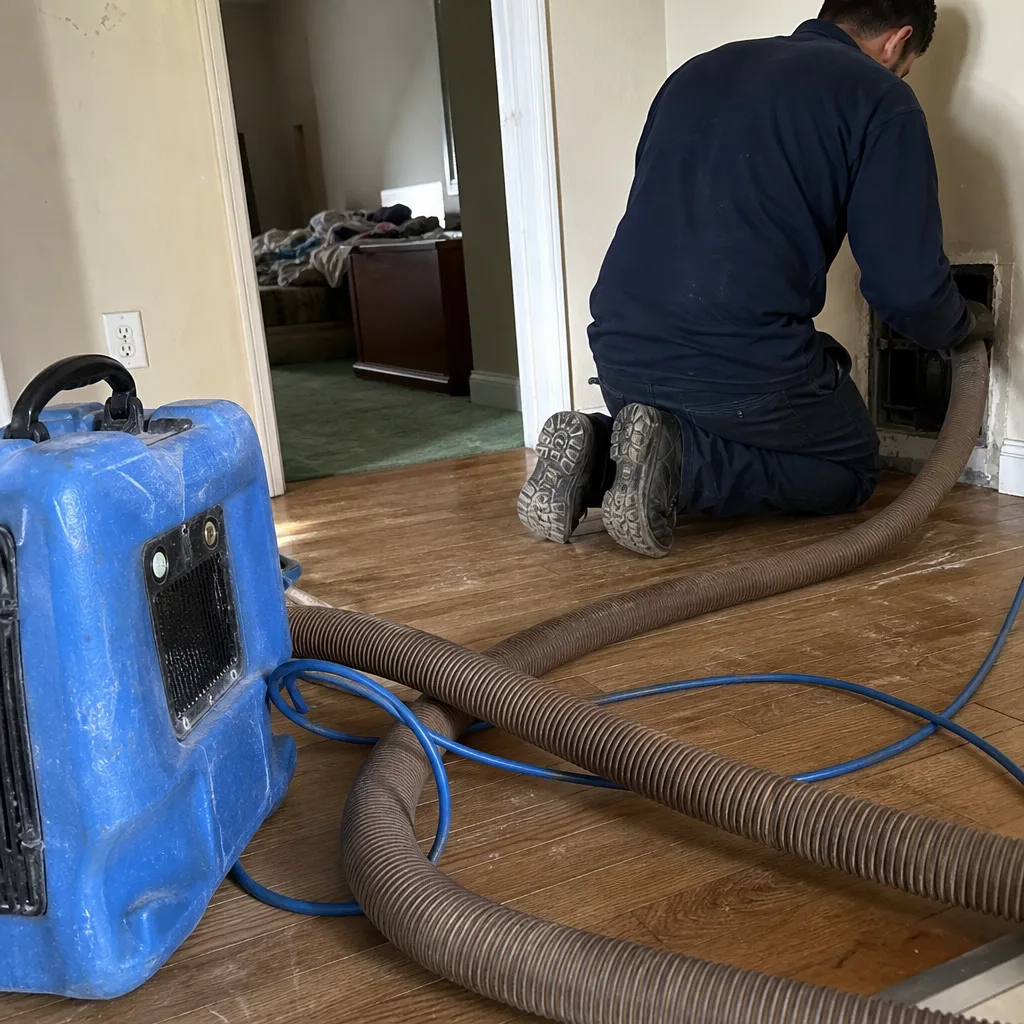
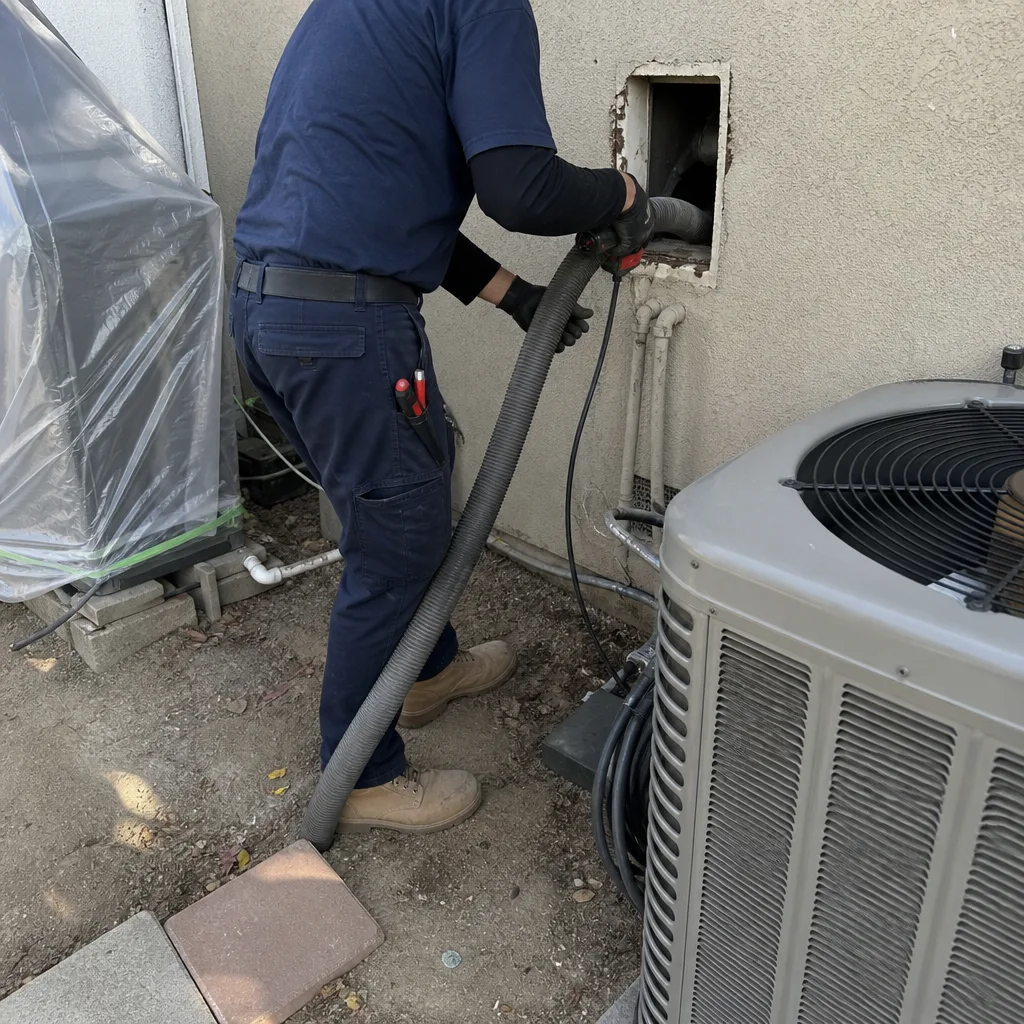
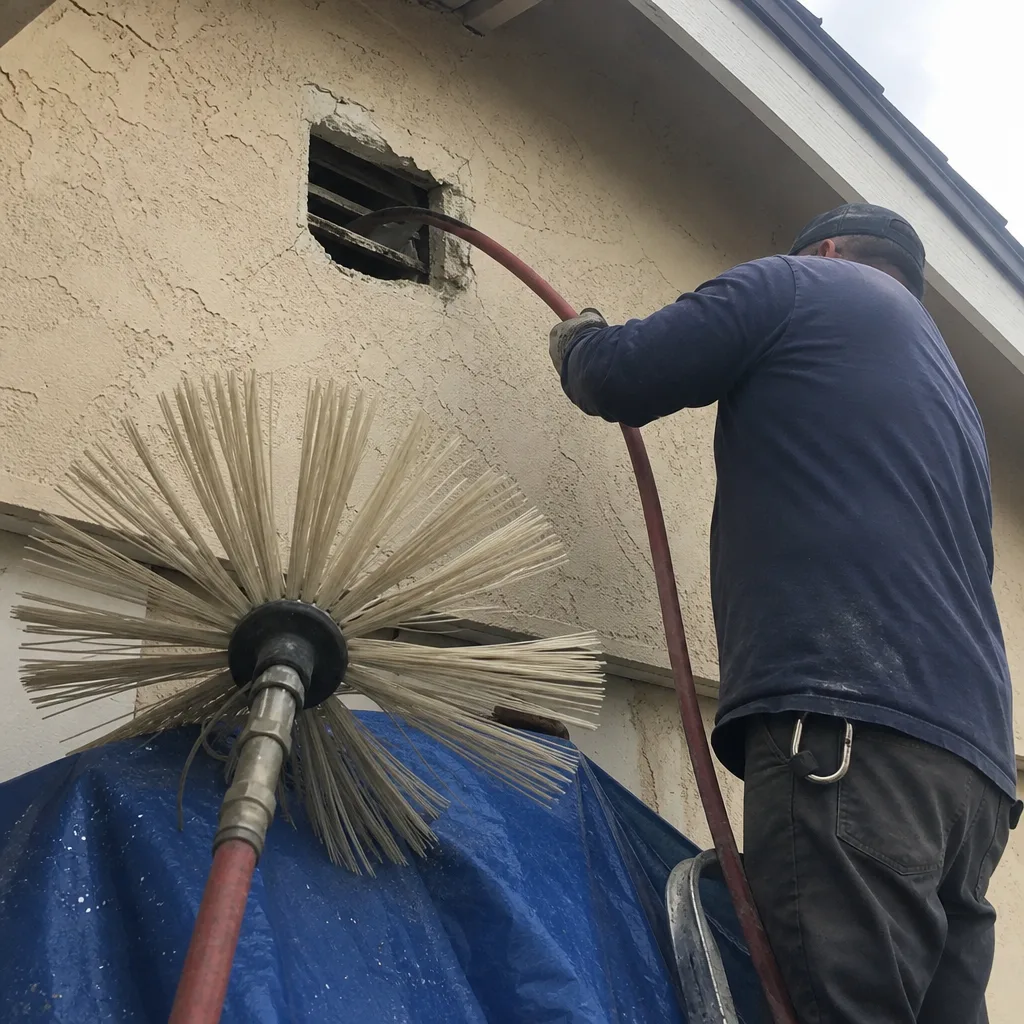
We use Rotobrush and Nikro professional duct-cleaning systems for this work, which matters for a specific reason: these are the same contractor-grade tools used in commercial and light-commercial HVAC work, not consumer shop-vac setups. The difference is in the agitation method and the negative-pressure capture. A proper post-smoke cleaning requires agitation of the duct walls to release the soot film, followed by immediate negative-pressure removal so the loosened particulate is pulled outside rather than re-suspended into the living space. Equipment matters more for smoke remediation than for routine dust removal because smoke soot is finer and adheres more tightly to duct surfaces.
Pico Rivera homes have a mix of duct types, including flexible duct in many of the tract developments and rigid metal ducts in older homes. Smoke remediation differs slightly between the two. Flexible ducts require lower agitation pressure to avoid damaging the inner liner, while rigid ducts can tolerate a more aggressive approach. A specialist who understands this distinction will get better results without causing damage that then requires a separate repair call. That is also why repair capability matters: if the inspection reveals a compromised boot or a crushed flex run, the same company should be able to address it on the same visit. Our service scope includes air duct repair as a core offering, not just cleaning, which means a post-emergency inspection does not end with a recommendation to call someone else if damage is found.
Dryer Vent Emergency Prep: Ember Intrusion and Wind Events
The dryer vent system is the part of a home most often overlooked in emergency preparedness discussions, and it is also one of the most important in fire-adjacent and high-wind communities. In Pico Rivera, the relevant scenarios are Santa Ana wind events and the occasional wildfire that pushes embers into populated areas. A dryer vent that is partially blocked with lint is not just a routine fire hazard. Under wind-driven ember conditions, it becomes a documented ignition pathway.
The mechanism is straightforward. Wind embers can travel significant distances, and they enter the home through any exterior opening that does not have a proper self-closing damper or screen. The dryer vent exterior termination is one of the few openings in a home that leads directly to a highly combustible material: accumulated lint. When an ember enters the vent and contacts a lint accumulation, ignition can occur inside the vent run, where it is not immediately visible and where it has access to the wall cavity through the penetration.
Preparation for wind events in Pico Rivera should include a dryer vent cleaning before the high-wind season begins. The goal is to remove the fuel source so that even if an ember enters the vent, there is nothing for it to ignite. The same protocol applies before any wildfire event that places the city under a red flag warning. A clean vent is not a guarantee against ignition, but it removes the most obvious fuel load and reduces the risk substantially.
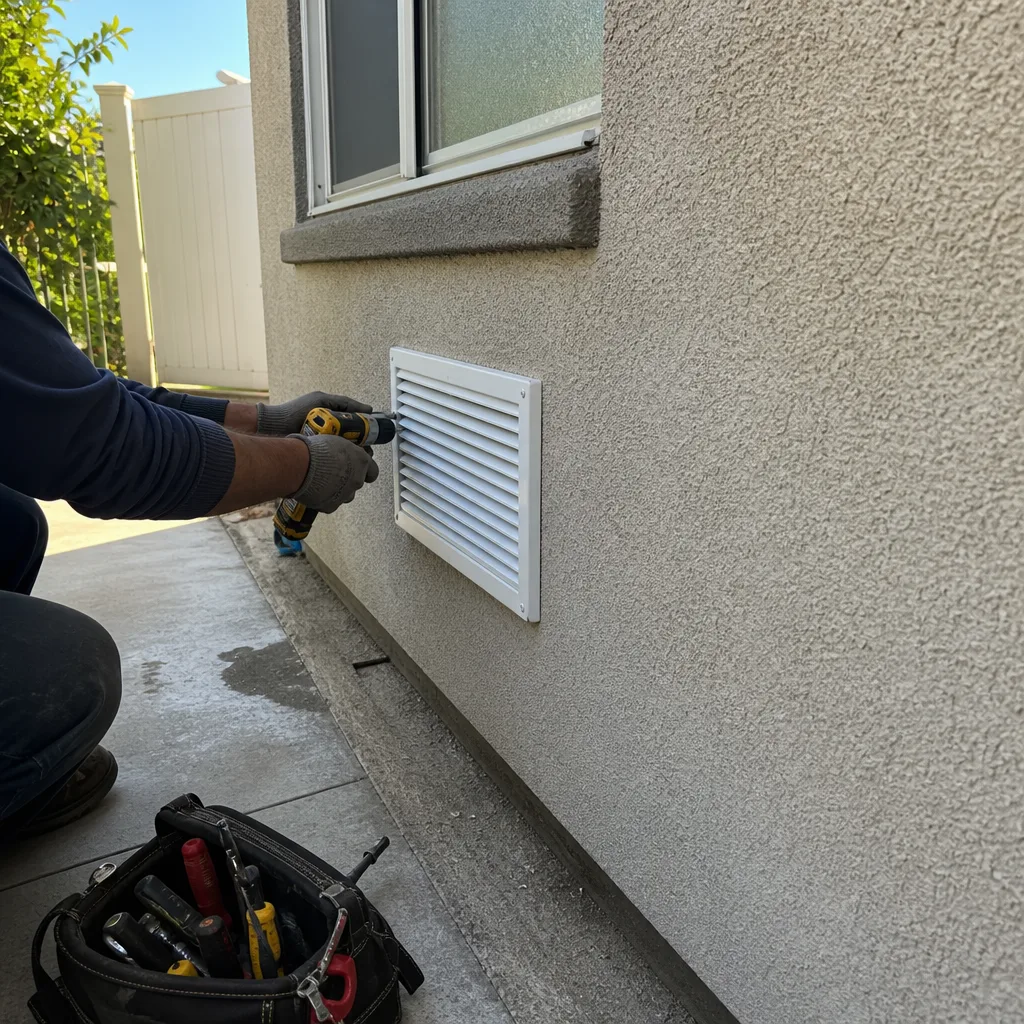
Beyond cleaning, there is a hardware component. If your dryer vent terminates with a louvered flap that does not close completely, or if the termination is missing entirely, the system is exposed to both ember intrusion and driven rain. A properly functioning louvered termination with a fine mesh bird guard provides the baseline level of protection. Do not replace it with a solid cover because that creates a restriction that will cause lint buildup and reduce dryer efficiency. The right termination lets air and lint out while keeping embers and wildlife out.
Treating the dryer vent as a serious safety issue rather than an upsell afterthought is core to how we work. The vent is a part of the home’s air pathway, and it interacts with the same wind and particulate conditions that affect the HVAC system. A homeowner who has their ducts cleaned but ignores the dryer vent has addressed half the problem. Both systems move air through the building envelope and both can be affected by the same outdoor event.
Filter Selection: What MERV Rating to Have on Hand
The MERV rating on a filter is a measure of its effectiveness at capturing particles of different sizes. The scale runs from 1 to 16 for residential applications. The relevant question for Pico Rivera homeowners is what rating to keep installed during normal conditions and what rating to have available during a smoke event. The answer is not “the highest rating you can find.”
For normal operation, a MERV 11 filter is a reasonable default for most residential systems. It captures dust, pollen, and pet dander without imposing an airflow penalty that would tax the blower. Homes with pets or allergy-sensitive occupants may find MERV 11 sufficient, while others may choose to move up to MERV 13 for year-round use. The critical constraint is static pressure: every filter adds resistance to airflow, and if the system was not designed for a high-MERV filter, installing one can reduce airflow substantially. This is especially relevant for older Pico Rivera homes where the duct system may already have higher-than-ideal static pressure due to age or poor installation.
Before wildfire season, we recommend having a MERV 13 filter on hand, even if you do not normally run one. When a smoke event arrives, the MERV 13 filter is the single most effective thing you can install to protect your indoor air quality. It captures particles in the 0.3 to 1.0 micron range, which is where the majority of harmful smoke particulate resides. A MERV 13 filter is not a HEPA filter; it is a reasonable, available, and cost-effective compromise for systems that were not designed for hospital-grade filtration. If you have a respiratory condition or a household member who is immunocompromised, in-room HEPA units are a better supplemental approach than trying to over-filter the central system.
We work with air-quality brands including Aprilaire and Abatement Technologies, which are associated with allergen control and higher-grade filtration in residential and commercial settings. That does not mean every home needs a specialized filtration upgrade. It means that if a homeowner wants to move beyond the standard one-inch filter, there are options worth discussing. The right answer depends on the specific system, the home’s leakage rate, and the occupants’ health priorities.
The key functional detail most homeowners miss is that a filter only works if it seals. A MERV 13 filter in a poorly fitting filter rack lets smoke bypass the filter through the gaps around the frame. If you can see light around the edges of the installed filter, the filter is not doing its job during a smoke event. A properly sealed filter rack matters as much as the filter rating.
Common Mistakes to Avoid
- Changing the filter during the smoke event and then never inspecting the system afterward. A saturated filter is evidence that the system captured particulate, but it does not tell you what bypassed or what settled in the ducts. The filter change is step one, not the final step.
- Rushing to clean the ducts before inspecting them. Running cleaning tools through a system with an unknown condition can cause unnecessary damage or miss the sections that actually need attention. Inspection first, then a cleaning decision.
- Running the system in “auto” mode during a smoke event with a standard filter. This is the worst of all worlds: intermittent operation pulls smoke through the system, the low-MERV filter catches almost none of it, and the particulate settles in the ducts between cycles. If you cannot install a high-MERV filter, shut the system off.
- Opening windows to air out the house as soon as the smoke clears. This pulls residual outdoor particulate back into the home and into the return air grilles. Wait for sustained clean-air readings and ventilate through a system with a clean filter if possible.
- Ignoring the dryer vent during fire season. A lint-loaded vent is a fuel source, not just a nuisance. If the vent has not been cleaned in the past year and a red flag warning is issued, schedule the service before the wind arrives.
- Assuming a system that “sounds fine” does not need attention. Smoke soot does not make a blower motor sound different in the early stages. It sits on the coil, the duct walls, and the housing until enough accumulates to cause airflow problems. Noise is a lagging indicator, not a leading one.
When to Call a Professional
There is a point where homeowner effort hits its limit. If your post-event inspection reveals soot streaking inside return boots, a coated air handler coil, restricted airflow, or visible particulate around supply registers, the system needs professional attention. A proper scope and inspection requires equipment and access that most homeowners do not have, and the cleaning itself requires negative-pressure capture to avoid resuspending smoke particulate into the living space. If the ducts have not been cleaned, if there is evidence of a duct leak or damage, or if a smoke event lasted more than 48 hours with the system running, call a specialist who can evaluate the full air pathway. Duct Cleaning Pico Rivera offers free estimates in Pico Rivera. Call (833) 734-6877. We answer 24/7. Fast dispatch from 7am to 7pm, Sunday through Friday.
Frequently Asked Questions
The price depends entirely on the size of the system and the distribution of soot, which is why we do not quote before an inspection. A post-emergency cleaning has to be scoped after someone sees what actually accumulated. The estimate is free, and the written estimate sets the final price before any work begins.
A high-MERV filter captures a significant portion of smoke particulate, but no filter captures everything, and particulate that bypasses a poorly sealed filter settles in the ducts. Think of the filter as the first line of defense, not the only one. The ducts, coil, and return boards still need to be inspected after a sustained event.
You can and should check the visible items: filter condition, filter housing, return grilles, and supply registers. What you cannot reasonably check without professional equipment is the coil condition and the interior of the main trunk lines. If the visible areas show soot streaking, assume the hidden areas need attention too.
It should be done as soon after the event as is practical, once outdoor air quality has stabilized. There is no benefit to waiting because the soot does not degrade or settle out on its own. It sits in the system and gets recirculated every time the blower runs. Waiting weeks or months simply extends the period of exposure.
A home in eastern Pico Rivera, away from the 710 corridor, still gets the same wildfire smoke and the same regional particulate as any other home in the LA Basin. The difference is frequency and magnitude, not zero risk. Every forced-air system accumulates, and every system benefits from an occasional professional cleaning, especially after a known event.
Cheap duct-cleaning offers typically come from crews using consumer-level vacuums and no agitation equipment, so they remove loose surface dust but leave the adhered soot film behind. They also typically do not inspect the coil, repair damage, or address the dryer vent. A lower price often means less equipment, less scope, and no follow-through on the actual problem.
The Bottom Line
Air quality emergencies are a recurring reality in Pico Rivera, and they leave a measurable residue in the systems that move air through your home. The path to protecting your household runs through preparation: the right filter before the smoke arrives, the discipline to shut down or run recirculation mode correctly during the event, and the patience to inspect before cleaning when it is over. Pre-event planning, proper filter selection, and a post-event inspection sequence are the three pillars that determine whether your system recovers cleanly or recirculates particulate for months. The work is straightforward, but skipping steps costs more than most homeowners expect. And the time to prepare for the next event is before the AQI starts climbing again.
Written by the team at Duct Cleaning Pico Rivera, serving Pico Rivera since 2011.
See the difference
 Before
 After
 Before
 After
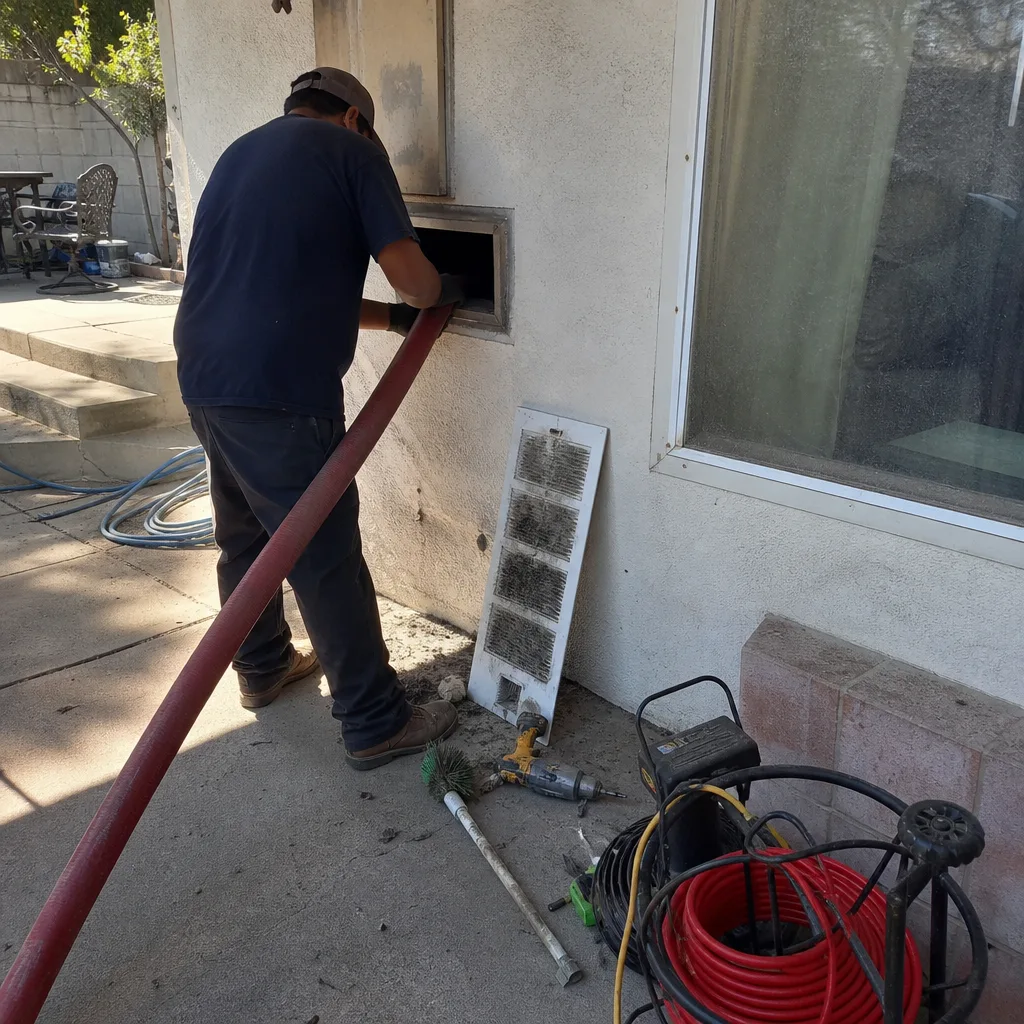 Before
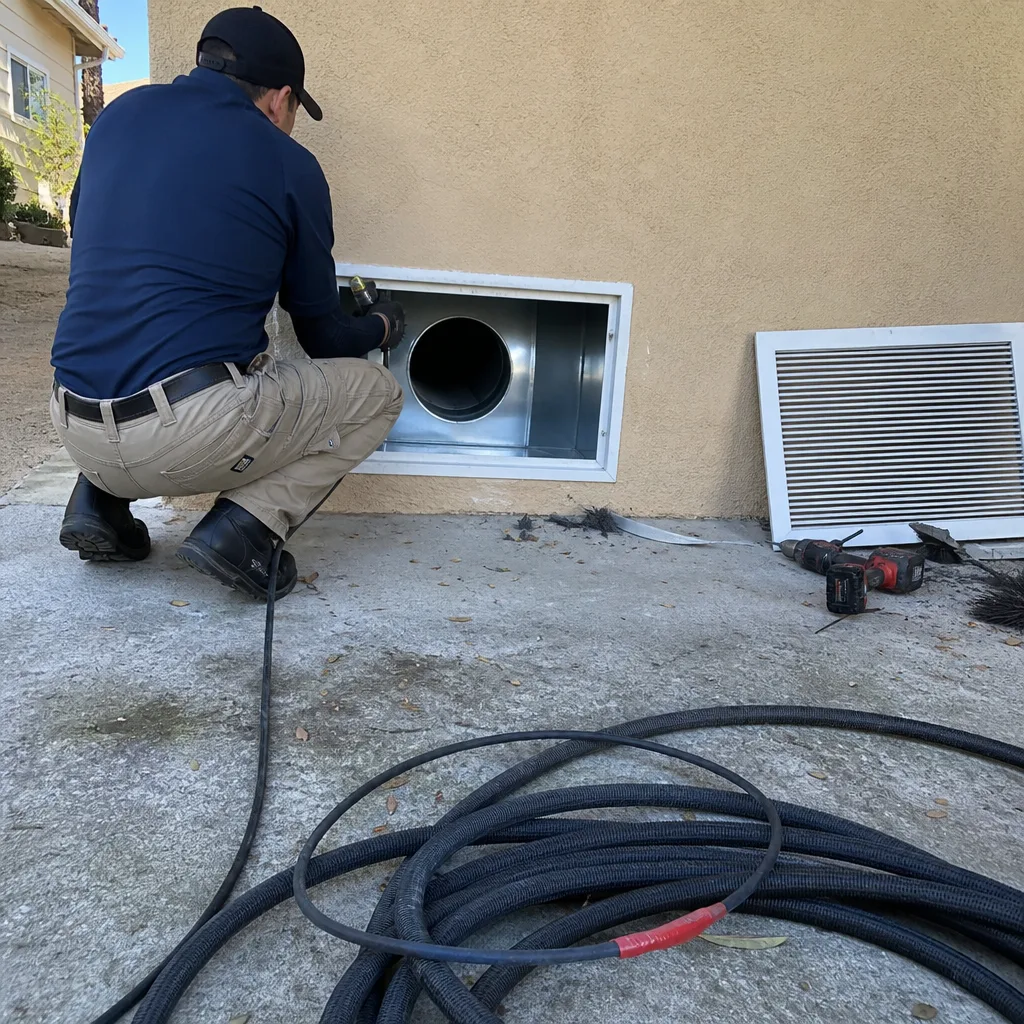 After